CATEGORY: Goldfish
Setting up a goldfish aquarium is one of the most rewarding parts of fishkeeping, but it is also where many beginners make costly mistakes. Goldfish are often sold as easy starter pets that can live happily in small bowls with minimal care. In reality, they are active, intelligent fish that require spacious aquariums, excellent filtration, and a stable environment to thrive.
A properly designed aquarium not only keeps your goldfish healthy but also allows them to display their natural behaviors, vibrant colors, and curious personalities. Whether you are preparing a home for a single fancy goldfish or a group of common goldfish, careful planning will make maintenance easier and significantly increase your fish’s lifespan.
This complete guide explains every step involved in creating the ideal goldfish aquarium.
—
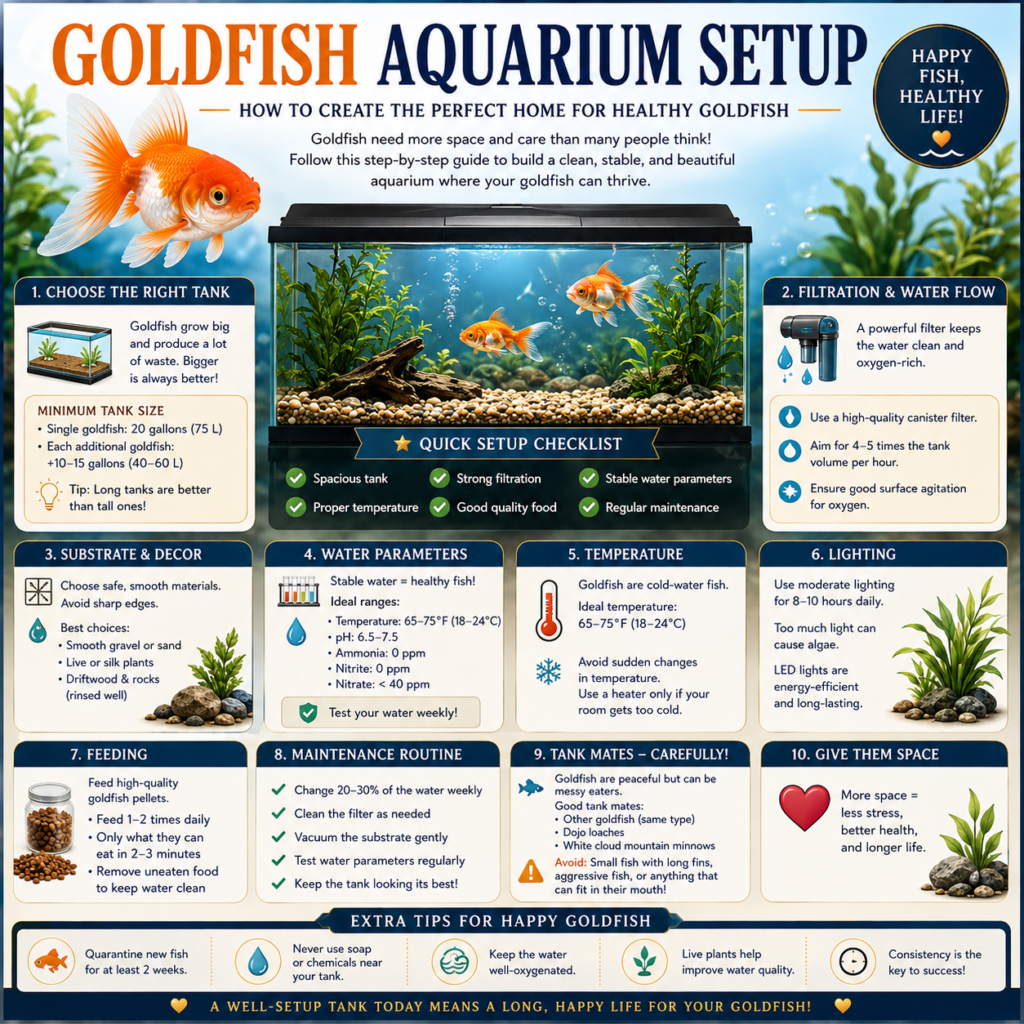
Choosing the Right Aquarium
The aquarium itself is the foundation of successful goldfish keeping.
A larger aquarium offers several important advantages:
- More stable water chemistry
- Better oxygen levels
- Greater swimming space
- Easier maintenance
- Reduced stress
- Slower waste buildup
Contrary to popular belief, larger aquariums are often easier to manage than small ones because changes in water quality occur more gradually.
—
Recommended Aquarium Sizes
Goldfish grow much larger than most beginners expect.
General recommendations are:
Fancy Goldfish
- First fish: at least 75 liters (20 gallons)
- Each additional fish: approximately 40 liters (10 gallons)
Common, Comet, and Shubunkin Goldfish
- First fish: 110–150 liters (30–40 gallons)
- Groups require substantially larger aquariums or outdoor ponds
Planning for the adult size of your fish avoids the need for frequent upgrades.
—
Choosing the Aquarium Shape
Long aquariums are generally preferable to tall ones.
They provide:
- Greater swimming distance
- Better oxygen exchange
- More usable floor space
- Improved viewing angles
Tall, narrow tanks may look attractive but offer less practical swimming room.
—
Selecting the Best Location
Place the aquarium:
- Away from direct sunlight
- On a strong, level stand
- Near electrical outlets
- Away from heating or cooling vents
- In a quiet area with moderate activity
Avoid placing aquariums near windows where sunlight encourages excessive algae growth and causes temperature fluctuations.
—
Installing a Quality Filter
Goldfish are heavy waste producers, making filtration one of the most important investments.
Choose a filter capable of circulating:
6–10 times the total aquarium volume every hour.
For example:
A 200-liter aquarium should ideally use a filter rated for 1,200–2,000 liters per hour.
—
Types of Filters
Hang-on-Back Filters
Advantages:
- Easy to install
- Affordable
- Good biological filtration
Suitable for many fancy goldfish aquariums.
—
Canister Filters
Advantages:
- Excellent filtration capacity
- Large biological media volume
- Quiet operation
- Easy maintenance
Often considered the best option for medium and large goldfish aquariums.
—
Sponge Filters
Benefits include:
- Gentle water movement
- Safe for fry
- Excellent biological filtration
They are commonly used alongside another primary filter.
—
Cycling the Aquarium
Before introducing fish, the aquarium must establish beneficial bacteria through the nitrogen cycle.
The cycle converts:
Ammonia → Nitrite → Nitrate
Both ammonia and nitrite are highly toxic, while nitrate can be controlled through regular water changes.
Cycling may take several weeks but greatly improves long-term fish health.
—
Choosing the Right Substrate
Goldfish frequently explore the bottom while searching for food.
Safe options include:
Smooth Gravel
- Attractive appearance
- Easy cleaning
- Widely available
Choose gravel pieces too large to swallow.
—
Sand
Many goldfish enjoy digging through fine aquarium sand.
Advantages:
- Natural appearance
- Gentle on mouths
- Easy for foraging
—
Bare Bottom
Some experienced keepers prefer no substrate.
Benefits:
- Simplest cleaning
- Easier waste removal
- Useful for quarantine aquariums
—
Decorating the Aquarium
Decorations should enhance the aquarium without creating hazards.
Good choices include:
- Rounded rocks
- Smooth driftwood
- Ceramic caves
- Aquarium-safe ornaments
Always leave plenty of open swimming space.
—
Decorations to Avoid
Avoid:
- Sharp rocks
- Rough artificial coral
- Narrow tunnels
- Decorations with sharp edges
- Metal objects
Fancy goldfish have delicate fins that tear easily.
—
Live Plants
Although goldfish nibble vegetation, many plants survive successfully.
Excellent choices include:
- Java Fern
- Anubias
- Hornwort
- Vallisneria
- Amazon Sword
- Water Sprite
Floating plants can also help reduce excess nutrients.
—
Lighting
Goldfish do not require specialized lighting.
Provide approximately:
8–10 hours of light daily.
Using a timer helps establish a consistent day-night cycle while reducing algae growth.
—
Heating
Goldfish are cold-water fish.
Most indoor homes naturally maintain appropriate temperatures.
A heater may still be useful if:
- Room temperatures fluctuate dramatically.
- Winter temperatures become unusually low.
Stable temperatures are more important than slightly warmer water.
—
Water Conditioner
Tap water often contains chlorine or chloramine.
Always use a quality water conditioner before adding tap water to the aquarium.
Never place untreated tap water directly into a goldfish tank.
—
Water Testing
Regular testing prevents many common problems.
Monitor:
- pH
- Ammonia
- Nitrite
- Nitrate
Liquid test kits are generally more accurate than paper strips.
—
Air Pumps
Goldfish appreciate highly oxygenated water.
Air pumps are especially beneficial when:
- The aquarium is heavily stocked.
- Water temperatures rise.
- Oxygen levels decrease.
- Additional water movement is desired.
Although not always essential, they often improve circulation and surface agitation.
—
Aquarium Lid
A secure lid provides several advantages.
It:
- Reduces evaporation
- Prevents fish from jumping
- Keeps dust out
- Supports lighting systems
Always leave small openings for equipment as needed.
—
Introducing Goldfish
Never place newly purchased fish directly into the aquarium.
Instead:
- Float the transport bag for 15–20 minutes to equalize temperature.
- Gradually mix small amounts of aquarium water into the bag.
- Gently transfer the fish using a net.
- Avoid pouring store water into the aquarium.
Slow acclimation minimizes stress.
—
Quarantine Aquarium
If adding new fish to an established aquarium, quarantine them first.
A quarantine period of several weeks helps detect:
- Parasites
- Bacterial infections
- Fungal diseases
This simple step protects your existing fish.
—
Compatible Tank Mates
Good companions include:
- Other goldfish of similar type
- White Cloud Mountain Minnows
- Weather Loaches (in suitable setups)
- Certain Hillstream Loaches
Avoid:
- Tropical fish
- Aggressive species
- Fin nippers
- Very small fish
Fancy goldfish are best housed with other fancy varieties.
—
Feeding Station
Many owners feed in the same area of the aquarium every day.
Benefits include:
- Easier observation
- Reduced leftover food
- Familiar routines for the fish
Goldfish quickly learn where meals are served.
—
Weekly Maintenance Routine
A simple routine keeps the aquarium healthy.
Each week:
- Change 25–40% of the water.
- Vacuum the substrate.
- Clean algae if necessary.
- Test water quality.
- Inspect fish for signs of illness.
- Rinse filter media using removed aquarium water.
Consistency is more important than occasional deep cleaning.
—
Common Beginner Mistakes
Many problems can be avoided by steering clear of these errors:
- Keeping goldfish in bowls
- Overstocking the aquarium
- Skipping the nitrogen cycle
- Overfeeding
- Ignoring water tests
- Cleaning the filter with tap water
- Replacing all filter media at once
- Mixing incompatible fish species
Learning proper husbandry from the beginning prevents many health issues later.
—
Signs of a Healthy Aquarium
A well-maintained goldfish aquarium typically has:
- Clear water
- Active fish
- Stable water parameters
- Minimal algae
- Healthy plant growth
- Efficient filtration
- No unusual odors
Healthy aquariums are usually stable rather than perfectly spotless.
—
Upgrading Your Aquarium
As goldfish grow, many owners eventually expand their setup.
Possible upgrades include:
- Larger aquarium
- More powerful filtration
- Live plants
- Automatic lighting timer
- Improved water testing equipment
- Canister filter
- Outdoor pond for suitable varieties
Gradual improvements often make fishkeeping even more enjoyable.
—
Final Thoughts
Creating the perfect goldfish aquarium is about far more than aesthetics. A spacious tank, reliable filtration, stable water conditions, and thoughtful decoration provide the foundation for a healthy environment where goldfish can flourish.
By planning your aquarium carefully from the start, performing regular maintenance, and understanding your fish’s natural needs, you will create a beautiful aquatic habitat that supports vibrant colors, active behavior, and a lifespan that can extend for decades. A properly designed goldfish aquarium rewards both beginner and experienced aquarists with years of enjoyment and the satisfaction of seeing these remarkable fish thrive.
The End,
PawBearing
 Discover More From Our Family of Websites
 ZodiacBearing (Astrology, Tarot, Numerology, Angel Numbers & Spiritual Guidance)
 Velourana (Beauty, Makeup, Hair Care, Skincare & Beauty Tips)
 HavenBearing (Home, Living, Organization, Décor & Everyday Inspiration)
 PawBearing (Pet Care, Dog Breeds, Animal Health, Training & Pet Products)
 PsyCatherine (Notes From the Journal of a Psychologist on Real Life)