CATEGORY: Affenpinscher
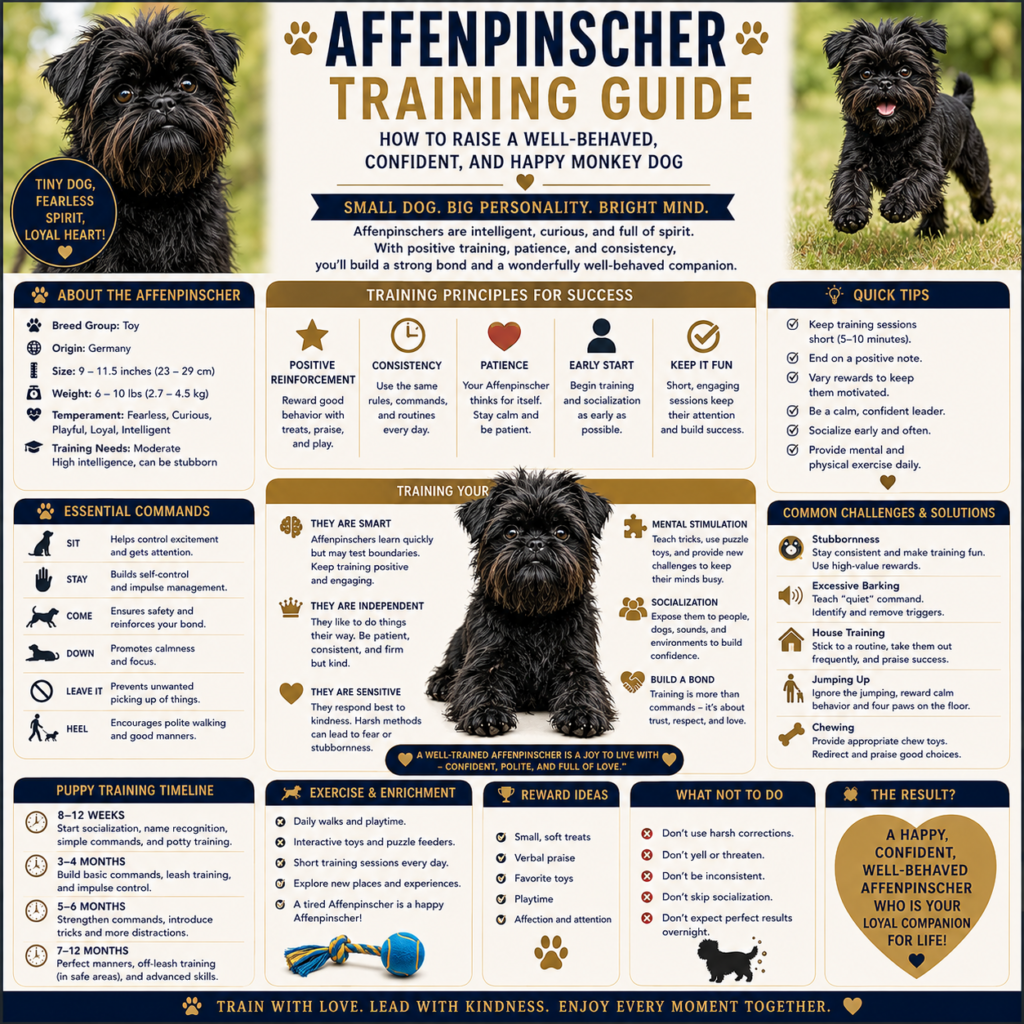
The Affenpinscher may be one of the smallest dog breeds, but it possesses an intelligence, confidence, and determination that rivals dogs many times its size. These qualities make the breed fascinating to live with, but they also mean that proper training is essential from an early age. An untrained Affenpinscher can become stubborn, noisy, or overly protective, while a well-trained one develops into a polite, adaptable, and deeply rewarding companion.
Training an Affenpinscher is not about controlling the dog’s personality—it is about guiding its natural intelligence in positive directions. Their curiosity and eagerness to explore the world make learning enjoyable when sessions are engaging, rewarding, and consistent.
This complete guide explains how to successfully train an Affenpinscher throughout every stage of life, from puppyhood to adulthood, while strengthening the lifelong bond between owner and dog.
Understanding the Affenpinscher Mind
Before beginning any training program, it is important to understand how the Affenpinscher thinks.
Unlike breeds developed primarily to obey commands instantly, the Affenpinscher was originally bred to work independently while hunting rats and mice. It often had to solve problems without human assistance, making decisions quickly and confidently.
Today, that heritage remains visible.
An Affenpinscher enjoys learning but also likes to think for itself. If training becomes repetitive or boring, it may simply decide to do something else.
Rather than seeing this as stubbornness, owners should recognize it as intelligence combined with independence.
The most successful training sessions are those that feel like games rather than chores.
Start Training Immediately
Training begins the day your puppy arrives home.
Many owners mistakenly believe they should wait until a puppy is older, but young Affenpinschers are already learning from every experience.
Even at eight weeks of age, puppies can begin understanding:
- Their name
- Household routines
- Where to sleep
- Toilet habits
- Gentle handling
- Family rules
- Simple commands
Early learning creates good habits that become easier to maintain throughout adulthood.
Waiting several months before beginning training often allows unwanted behaviors to become established.
Building Trust First
Every successful training program begins with trust.
Your Affenpinscher should view you as a source of safety, guidance, and enjoyable experiences.
Build trust by:
Being Consistent
Use the same commands and expectations every day.
Staying Calm
Avoid shouting or becoming frustrated during mistakes.
Rewarding Success
Celebrate even small achievements with praise or treats.
Respecting the Dog
Never force your dog into frightening situations during training.
A confident dog learns more quickly than one that feels anxious or confused.
Positive Reinforcement Works Best
Positive reinforcement is widely considered the most effective training method for the Affenpinscher.
Whenever your dog performs the desired behavior, immediately reward it with something valuable.
Rewards may include:
- Small training treats
- Verbal praise
- Gentle petting
- Favorite toys
- Short play sessions
The timing of the reward is extremely important.
Reward your dog within a few seconds so it clearly associates the reward with the correct behavior.
Punishment-based training often creates fear and damages the relationship between dog and owner without improving long-term learning.
Essential Commands Every Affenpinscher Should Learn
Basic obedience provides both safety and good manners.
The following commands form an excellent foundation.
Sit
Usually the easiest command for beginners and useful in countless daily situations.
Stay
Helps your dog remain calm while visitors arrive or doors are opened.
Come
One of the most important safety commands, especially outdoors.
Down
Encourages relaxation and self-control.
Leave It
Prevents your dog from picking up dangerous or inappropriate objects.
Drop It
Useful when retrieving toys or removing unsafe items from your dog’s mouth.
Wait
Teaches patience before meals, walks, or entering vehicles.
Mastering these commands makes everyday life smoother for both dog and owner.
House Training Success
House training requires patience rather than speed.
Because Affenpinschers have small bladders, puppies need frequent opportunities to relieve themselves.
Take your puppy outside:
- After waking up
- After eating
- After drinking
- After playing
- Before bedtime
- Every few hours throughout the day
Always reward successful outdoor toileting immediately.
If accidents occur indoors, simply clean the area thoroughly without punishment.
Consistency is the key to long-term success.
Crate Training
When introduced correctly, a crate becomes a safe personal space rather than a punishment.
Many Affenpinschers naturally enjoy having a quiet place to rest.
Introduce the crate gradually by:
- Placing comfortable bedding inside
- Leaving the door open initially
- Feeding meals near the crate
- Offering treats inside
- Allowing voluntary exploration
Never force your dog into the crate or use it as punishment.
A positive introduction creates lifelong comfort with crate use.
Socialization Is Part of Training
Training extends beyond learning commands.
Socialization teaches puppies how to behave confidently in everyday situations.
Introduce your Affenpinscher to:
Different People
Adults, children, and people wearing hats, uniforms, or sunglasses.
Friendly Dogs
Supervised meetings with vaccinated, well-behaved dogs.
New Environments
Parks, sidewalks, pet-friendly shops, and quiet public areas.
Everyday Sounds
Vacuum cleaners, traffic, bicycles, doorbells, and household appliances.
Positive early experiences reduce fear and build confidence.
Preventing Excessive Barking
Affenpinschers are naturally alert watchdogs.
They quickly notice unusual sounds or unfamiliar visitors.
While alert barking is normal, excessive barking should be managed early.
Helpful strategies include:
- Teaching the “Quiet” command.
- Rewarding silence.
- Providing mental stimulation.
- Preventing boredom.
- Avoiding accidental reinforcement.
Ignoring unnecessary barking while rewarding calm behavior usually produces the best long-term results.
Mental Exercise Matters
Physical exercise alone is not enough for this intelligent breed.
Mental stimulation prevents boredom and encourages appropriate behavior.
Excellent activities include:
- Food puzzles
- Hide-and-seek games
- Scent work
- Learning tricks
- Interactive toys
- Short obedience sessions
A mentally satisfied Affenpinscher is generally calmer and easier to manage.
Common Training Mistakes
Even experienced owners sometimes make mistakes that slow progress.
Avoid the following:
Inconsistent Rules
Allowing a behavior one day but correcting it the next creates confusion.
Long Training Sessions
Short, enjoyable lessons are far more productive than lengthy ones.
Repeating Commands
Say a command once, then guide your dog toward success instead of repeating it multiple times.
Punishing Mistakes
Dogs learn best through guidance rather than fear.
Skipping Socialization
Lack of early exposure may contribute to fearfulness later in life.
Teaching Fun Tricks
Because Affenpinschers are intelligent and naturally entertaining, many enjoy learning tricks beyond basic obedience.
Popular tricks include:
- Shake hands
- Spin
- Roll over
- High five
- Fetch small toys
- Ring a bell
- Jump through a hoop
- Bow
Learning tricks strengthens communication while providing valuable mental exercise.
Training Through Adolescence
Between six and twelve months of age, many Affenpinschers enter adolescence.
During this period they may:
- Become more independent.
- Test boundaries.
- Ignore familiar commands.
- Become easily distracted.
This stage is completely normal.
Continue practicing basic commands consistently while remaining patient.
Most dogs regain reliability as maturity develops.
Lifelong Learning
Training does not end once basic commands are mastered.
Continuing to teach new skills throughout adulthood helps maintain mental sharpness and strengthens your relationship.
Even senior Affenpinschers enjoy learning new games, puzzles, and tricks.
Regular training sessions also provide valuable opportunities to monitor your dog’s hearing, mobility, and overall health.
Final Thoughts
Training an Affenpinscher is one of the most rewarding aspects of owning this remarkable breed. Their intelligence, curiosity, and lively personality make every lesson unique, while their independent spirit encourages owners to become patient, creative teachers.
By focusing on positive reinforcement, early socialization, consistent routines, and regular mental stimulation, owners can raise a confident, polite, and well-adjusted companion. The effort invested during training pays lifelong dividends, creating an Affenpinscher that is not only obedient but also emotionally secure, eager to learn, and a true joy to live with.
—
The End
PawBearing.com
 Discover More From Our Family of Websites
 ZodiacBearing (Astrology, Tarot, Numerology, Angel Numbers & Spiritual Guidance)
 Velourana (Beauty, Makeup, Hair Care, Skincare & Beauty Tips)
 HavenBearing (Home, Living, Organization, Décor & Everyday Inspiration)
 PawBearing (Pet Care, Dog Breeds, Animal Health, Training & Pet Products)
 PsyCatherine (Notes From the Journal of a Psychologist on Real Life)