CATEGORY: Alternative names
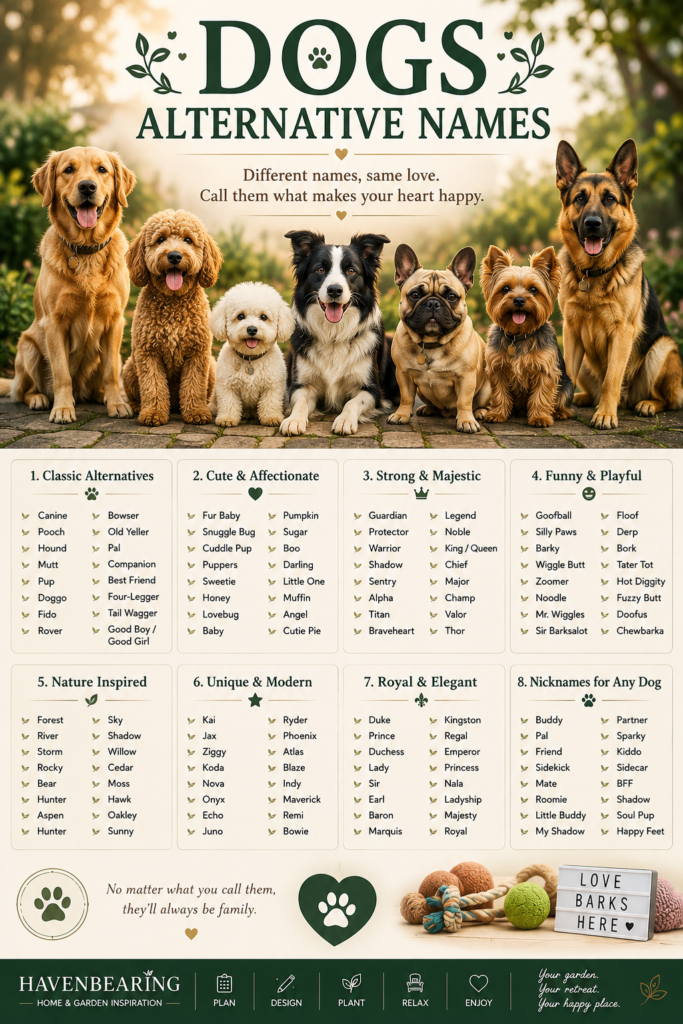
The English language contains a remarkable variety of words connected with dogs. While the word dog is the standard term used today, history, literature, hunting traditions, farming communities, and everyday conversation have produced dozens of alternative names describing different types of dogs. Some of these words refer to specific working roles, others describe ancestry, while some have evolved into affectionate nicknames or even negative insults depending on context.
Terms such as hound, wolfdog, cur, mongrel, mutt, and canine appear regularly in books, newspapers, films, veterinary discussions, and conversations among dog enthusiasts. Yet many people are uncertain about what these words actually mean or how they differ from one another.
Understanding these names is useful because they often carry historical significance. A “hound” is not simply another word for dog. A “mutt” is not identical to a “mongrel.” A “cur” originally described something very different from the way the word is sometimes used today. Some terms have remained technical, while others have changed dramatically as language evolved.
Exploring these alternative names reveals not only how humans have classified dogs over the centuries but also how closely language reflects the many different roles dogs have played in society.
Canine – The Scientific and Formal Name
Perhaps the most widely recognised alternative to the word “dog” is canine.
The term originates from the Latin word canis, meaning dog.
Today, “canine” appears frequently in scientific writing, veterinary medicine, zoology, and law enforcement. For example, police dogs are often referred to as police canines, and veterinarians commonly describe diseases or anatomy using the adjective canine.
Unlike many other alternative names, canine does not describe a particular breed or type of dog. Instead, it is a formal biological term referring broadly to members of the dog family.
Because of its scientific background, it tends to appear in professional settings rather than everyday conversation.
Hound – More Than Just Another Dog
The word hound has existed in English for many centuries.
Originally, it simply meant dog.
Over time, however, its meaning became more specialised.
Today, a hound generally refers to dogs developed for hunting.
Some hounds follow scents over long distances, such as Bloodhounds and Beagles.
Others rely primarily on exceptional eyesight, including Greyhounds, Salukis, and Whippets.
Although all hounds are dogs, not all dogs are hounds.
The term therefore describes an important group of working breeds with distinctive histories and abilities.
Wolfdog – A Dog with Wolf Ancestry
A wolfdog is not merely a large dog that resembles a wolf.
The term refers to animals produced by crossing domestic dogs with wolves.
Different wolfdogs contain varying proportions of wolf ancestry depending on their breeding history.
Because wolfdogs often display behavioural characteristics that differ from ordinary domestic dogs, ownership is regulated or restricted in some countries.
It is important not to confuse wolfdogs with breeds that simply have wolf-like appearances, such as the Siberian Husky, Alaskan Malamute, or Czechoslovakian Wolfdog, whose breeding histories are more complex.
The word therefore carries a specific biological meaning rather than describing appearance alone.
Cur – A Word with a Long History
The word cur has changed considerably over time.
Historically, it referred to working farm dogs used for herding livestock, guarding property, and performing practical tasks around rural homes.
Several recognised American breeds still include the word in their official names, such as the Black Mouth Cur, Mountain Cur, and Treeing Cur.
However, outside these recognised breed names, “cur” gradually developed a negative meaning in English and sometimes came to describe an aggressive, mixed-breed, or poorly behaved dog.
Today, context is important.
Within breed names it remains entirely neutral.
Used as an insult, it carries a very different meaning.
Mongrel – Mixed Heritage
The word mongrel traditionally describes a dog whose ancestry includes multiple breeds rather than a documented pedigree.
For many years, the word was used neutrally within veterinary medicine and animal welfare.
Over time, however, some people began associating it with lower value or uncertain breeding, giving the word an unfairly negative reputation.
In reality, mixed-breed dogs often enjoy excellent health, unique appearances, and wonderful personalities.
Many rescue organisations now prefer terms such as mixed-breed dog because they avoid negative historical associations while describing exactly the same idea.
Mutt – An Affectionate Modern Alternative
Among dog owners, mutt has become one of the most affectionate words for mixed-breed dogs.
Unlike mongrel, which sometimes sounds formal or outdated, mutt is often used warmly and proudly.
Owners frequently describe rescued companions as “my mutt” with obvious affection.
Animal shelters and rescue organisations occasionally use the word positively when celebrating the individuality of mixed-breed dogs.
Its popularity reflects changing attitudes that increasingly value personality over pedigree.
Stray Dog
A stray dog is not defined by its breed.
Instead, the term describes ownership status.
A stray is any dog found wandering without an owner present.
Some strays are temporarily lost pets.
Others have been abandoned.
Animal welfare organisations work to identify owners whenever possible while providing shelter and care until permanent homes can be found.
The word therefore describes circumstance rather than ancestry.
Feral Dog
A feral dog differs from a stray.
Feral dogs live independently of humans and have adapted to surviving without regular human care.
They may form loose social groups, hunt for food, and avoid close contact with people.
Unlike recently lost pets, truly feral dogs often require specialised handling because they have had limited positive interaction with humans.
Understanding this distinction is important for animal welfare and conservation efforts.
Pedigree and Purebred
At the opposite end of the spectrum from mixed-breed terminology are the words pedigree and purebred.
A purebred dog belongs to a recognised breed with documented ancestry.
A pedigree records that ancestry across multiple generations.
These terms frequently appear in kennel club registrations, breeding programmes, and dog shows.
They describe documented lineage rather than quality of character.
Both pedigree and mixed-breed dogs can become exceptional companions depending upon responsible ownership and care.
Why Language Around Dogs Continues to Change
Language constantly evolves.
Words once considered completely ordinary may gradually disappear or acquire different meanings.
Modern animal welfare organisations increasingly prefer respectful, accurate terminology that avoids unnecessary negative associations.
Expressions such as “mixed-breed dog” have become more common than “mongrel” in many professional settings.
Similarly, affectionate words like “mutt” now celebrate individuality rather than implying inferiority.
These changes reflect society’s growing appreciation that every dog deserves kindness regardless of ancestry or appearance.
Final Thoughts
The many alternative names used for dogs reflect thousands of years of shared history between humans and their oldest animal companions. Some terms describe scientific classification, others refer to hunting traditions, working roles, ancestry, or ownership status, while many have evolved through changing language and culture. Understanding words such as canine, hound, wolfdog, cur, mongrel, mutt, stray, and feral allows us to appreciate both their historical origins and their modern meanings.
Perhaps the most important lesson is that these names describe different aspects of dogs rather than determining their value. Whether a dog is a purebred, a mixed-breed companion, a working hound, or a rescued mutt, loyalty, intelligence, and companionship are never defined by terminology alone. Every dog has its own story, and the language we use continues to reflect the remarkable relationship humans have shared with them for thousands of years.
The End
PawBearing
 Discover More From Our Family of Websites
 ZodiacBearing (Astrology, Tarot, Numerology, Angel Numbers & Spiritual Guidance)
 Velourana (Beauty, Makeup, Hair Care, Skincare & Beauty Tips)
 HavenBearing (Home, Living, Organization, Décor & Everyday Inspiration)
 PawBearing (Pet Care, Dog Breeds, Animal Health, Training & Pet Products)
 PsyCatherine (Notes From the Journal of a Psychologist on Real Life)