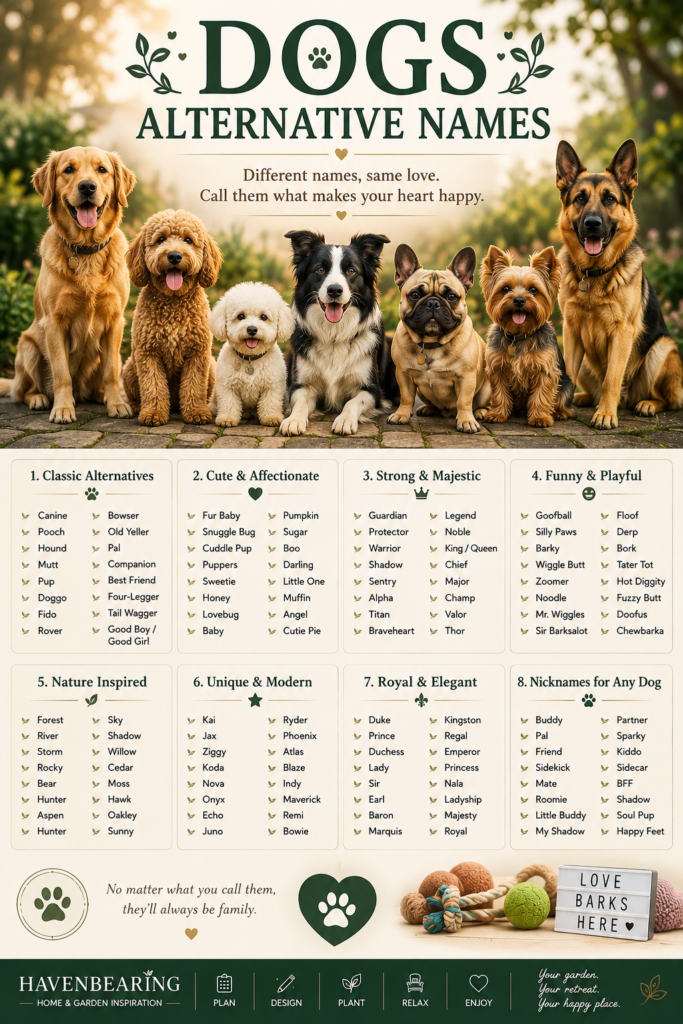
CATEGORY: Alternative Names
The language surrounding dogs is surprisingly rich. Beyond the simple word dog, there are hundreds of alternative names, historical terms, scientific expressions, breed nicknames, regional variations, and cultural differences that have developed over thousands of years. Some are still used every day, while others survive mainly in historical records, breeding literature, veterinary medicine, or folklore.
Many people encounter unfamiliar canine terminology when reading books, researching breeds, watching documentaries, or speaking with breeders and veterinarians. Questions naturally arise. What is the difference between a dog and a hound? Why do scientists say canine? Is a mutt the same as a mongrel? Why are some breeds known by abbreviations instead of their full names?
This guide brings together the most frequently asked questions about alternative dog names and provides clear, practical explanations. Understanding these terms not only improves communication but also offers a deeper appreciation of the remarkable history shared by humans and dogs across cultures, languages, and generations.
Why Are There So Many Different Names for Dogs?
Dogs have lived alongside humans for at least fifteen thousand years and probably much longer.
During that time, people spread across every continent, developing thousands of different languages and cultures.
Each society naturally created its own word for dog.
Additional names developed through hunting, farming, breeding, mythology, science, and literature.
As a result, modern canine vocabulary includes everyday words, technical terminology, affectionate nicknames, historical expressions, and breed-specific abbreviations.
Together, they reflect the extraordinary importance of dogs throughout human history.
What Is the Difference Between “Dog” and “Canine”?
Although both words describe the same animal, they are used differently.
Dog is the ordinary everyday word used in conversation.
Canine is a formal scientific or veterinary term derived from the Latin word Canis.
Veterinarians, zoologists, researchers, and law enforcement agencies frequently use canine because it provides precise terminology suitable for professional communication.
Most pet owners, however, naturally continue saying dog.
Is a Hound Different from a Dog?
Yes.
Every hound is a dog, but not every dog is a hound.
The word hound refers specifically to a group of breeds developed primarily for hunting.
Some hounds follow scent, such as Bloodhounds and Beagles.
Others rely mainly on exceptional eyesight, including Greyhounds and Salukis.
Historically, the word hound once meant dog in general, but modern English now reserves it for these specialised hunting breeds.
What Is the Difference Between a Mutt and a Mongrel?
Both words generally describe mixed-breed dogs.
Historically, mongrel was the more formal expression.
Over time, some people began associating it with negative stereotypes.
The word mutt has become increasingly popular because many owners use it affectionately and proudly.
Animal welfare organisations often prefer the neutral term mixed-breed dog, although mutt remains common in everyday conversation.
None of these words determines the quality, intelligence, or personality of the dog.
Why Do Some Breeds Have Nicknames?
Many official breed names are quite long.
For convenience, owners naturally shorten them.
Examples include:
Lab for Labrador Retriever.
Golden for Golden Retriever.
Yorkie for Yorkshire Terrier.
Aussie for Australian Shepherd.
GSD for German Shepherd Dog.
These nicknames simplify conversation while strengthening the sense of community among breed enthusiasts.
Some have become almost as famous as the official breed names themselves.
What Is the Correct Name for a Female Dog?
The traditional technical term is bitch.
Veterinary medicine, kennel clubs, and breeding organisations continue using this word because it provides precise biological description.
However, because the word has developed offensive meanings in modern everyday English when applied to people, many pet owners simply say female dog instead.
Both approaches are understood, although context remains important.
What Do Sire and Dam Mean?
These are standard breeding terms.
The sire is the father of a litter.
The dam is the mother.
Pedigree certificates, kennel registrations, and breeding records around the world continue using these traditional expressions because they provide clear and internationally recognised terminology.
Anyone researching pedigrees will encounter them frequently.
What Is the Scientific Name for the Domestic Dog?
The domestic dog is scientifically classified as:
Canis lupus familiaris
This reflects its close relationship with the grey wolf.
Scientists classify dogs within the genus Canis, alongside wolves, coyotes, and several related wild species.
Although everyday language varies greatly between countries, scientific classification remains internationally consistent.
Why Do Different Languages Use Different Words for Dogs?
Languages evolve independently.
As human communities became separated geographically, each developed its own vocabulary.
Some European languages share common roots because of historical connections.
Others, particularly in Asia, Africa, and the Americas, developed entirely different words.
Despite these linguistic differences, every culture recognised dogs as important companions and developed its own terminology to describe them.
Does a Dog’s Name Affect Training?
Research suggests that dogs respond more consistently to names that are short, easy to pronounce, and spoken consistently.
Most trainers recommend names containing one or two syllables because they are easier for both owners and dogs to recognise during everyday communication.
However, the actual word chosen matters far less than consistent repetition and positive reinforcement.
Dogs learn the sound of their own name rather than its dictionary meaning.
Are Historical Dog Names Still Popular Today?
Very much so.
Names inspired by mythology, history, and literature remain favourites among dog owners.
Examples include:
Cerberus
Hachikō
Balto
Lassie
Rin Tin Tin
Snoopy
Toto
Laika
These names remain popular because they already carry stories of loyalty, bravery, intelligence, adventure, or companionship.
Many owners enjoy giving their dogs names with meaningful historical connections.
Final Thoughts
The world of alternative dog names is far richer than it first appears. From scientific terminology and historical expressions to breed nicknames, collective nouns, international vocabulary, and famous canine names, every term reflects a different aspect of humanity’s long relationship with dogs. Learning these names not only improves understanding but also reveals fascinating stories about language, culture, history, and the many roles dogs have played throughout civilization.
Perhaps the most important lesson is that, regardless of the name used, dogs continue to represent loyalty, companionship, and trust across every culture on Earth. Whether someone says dog, canine, hound, mutt, chien, hund, inu, or perro, the affection behind the word remains remarkably universal. The language may change, but the bond between people and dogs has remained one of humanity’s greatest partnerships for thousands of years.
The End
PawBearing
 Discover More From Our Family of Websites
 ZodiacBearing (Astrology, Tarot, Numerology, Angel Numbers & Spiritual Guidance)
 Velourana (Beauty, Makeup, Hair Care, Skincare & Beauty Tips)
 HavenBearing (Home, Living, Organization, Décor & Everyday Inspiration)
 PawBearing (Pet Care, Dog Breeds, Animal Health, Training & Pet Products)
 PsyCatherine (Notes From the Journal of a Psychologist on Real Life)