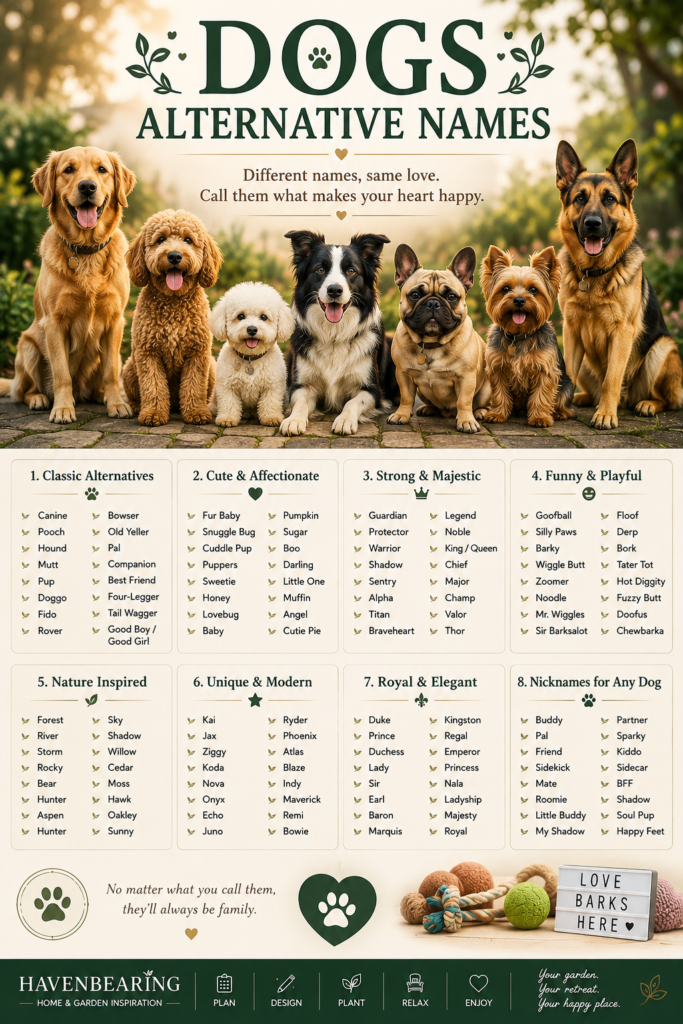
CATEGORY: Alternative names
Dogs have lived alongside humans for thousands of years, becoming hunters, guardians, shepherds, companions, workers, and beloved family members. During this remarkable shared history, every culture has developed its own words, nicknames, affectionate terms, and traditional names for these loyal animals. Some names describe a dog’s behaviour, others reflect its appearance or role, while many have evolved through language, folklore, and local customs.
Today, English speakers simply say “dog,” but that is only one of countless names used around the world. From the Latin canis to the French chien, the German Hund, the Spanish perro, the Japanese inu, and many others, each language tells part of the story of humanity’s relationship with dogs.
Alternative names are not only interesting from a linguistic perspective. They also reveal how different societies viewed dogs throughout history. In some cultures they were respected guardians of homes and livestock. In others they became royal companions, hunting partners, or spiritual symbols connected with myths and legends. Even today, many people choose unusual or foreign-inspired names for their own pets because they appreciate the meanings and traditions behind them.
Exploring the many names associated with dogs offers a fascinating glimpse into language, history, and culture while celebrating one of humanity’s oldest friendships.
The Difference Between a Dog’s Name and the Word for Dog
Before exploring different examples, it is useful to understand an important distinction.
When people speak about alternative names for dogs, they may actually mean two different things.
The first refers to the actual word used in a language to describe the animal itself.
For example:
- Dog (English)
- Chien (French)
- Hund (German)
- Perro (Spanish)
- Cane (Italian)
These are not pet names but the standard words used within those languages.
The second meaning refers to individual names people give their pets, such as Max, Bella, Charlie, Luna, or Rocky.
Both categories are interesting, but they serve different purposes. One belongs to language, while the other reflects personal choice and cultural trends.
Ancient Names for Dogs
Long before modern languages developed, ancient civilizations already had established words for dogs.
The Romans used the Latin word Canis, a term that survives today in scientific classification. The domestic dog remains scientifically known as Canis lupus familiaris, reflecting its relationship to wolves.
Ancient Greeks commonly used the word Kyon, from which several modern scientific and linguistic terms are derived.
In Ancient Egypt, dogs were respected as hunters and protectors. Some were even buried with their owners, demonstrating the important role they played within society. Historical records preserve numerous individual dog names, many describing strength, colour, speed, or loyalty.
These ancient words remind us that dogs have been companions to humans for many thousands of years, far longer than many other domesticated animals.
European Names for Dogs
Europe contains remarkable linguistic diversity, and nearly every language has its own traditional word for dog.
Some examples include:
- English – Dog
- French – Chien
- German – Hund
- Dutch – Hond
- Danish – Hund
- Swedish – Hund
- Norwegian – Hund
- Italian – Cane
- Spanish – Perro
- Portuguese – Cão
- Romanian – Câine
- Polish – Pies
- Czech – Pes
- Hungarian – Kutya
- Finnish – Koira
Although several of these words appear similar because of shared linguistic origins, others have developed entirely independently.
Interestingly, many European pet owners also use English-inspired names for their dogs alongside traditional local names, reflecting the global influence of English-language media.
Dog Names Across Asia
Asia’s enormous cultural diversity has produced an equally fascinating variety of names for dogs.
In Japan, the standard word is Inu, while Ken sometimes appears in compound words and traditional expressions.
In China, Mandarin speakers commonly use Gǒu.
In Korea, the word is Gae, although many Korean owners give their pets modern names influenced by English, Japanese, or Korean popular culture.
In India, dozens of different languages produce numerous words for dogs, reflecting the country’s extraordinary linguistic diversity.
Across Southeast Asia, additional variations appear in Thai, Vietnamese, Indonesian, Malay, and many other regional languages.
These words illustrate how one familiar animal has become woven into the everyday vocabulary of cultures separated by thousands of kilometres.
Traditional Working Dog Names
Throughout history, many dogs earned names based on the jobs they performed.
Shepherd dogs often received practical, easily recognised names because handlers needed to communicate clearly while working livestock over long distances.
Hunting dogs frequently received short, sharp names that could be called quickly during active hunts.
Guard dogs were often given strong names suggesting courage, vigilance, or protection.
Sled dogs working in Arctic regions frequently received names inspired by weather, snow, speed, or endurance.
These practical naming traditions continue today, particularly among working dog breeders who value clear communication alongside meaningful names.
Mythological and Legendary Dog Names
Many civilizations included famous dogs within their myths and legends.
Perhaps the best-known example is Cerberus, the enormous three-headed guardian of the underworld in Greek mythology.
Norse mythology tells of Garmr, a powerful guardian associated with Ragnarök.
Ancient Irish legends include remarkable hunting hounds connected with heroic warriors.
Many Native American traditions also feature dogs as loyal companions and spiritual guides.
These legendary names continue inspiring modern pet owners who appreciate mythology and ancient storytelling.
Choosing such a name often reflects admiration for bravery, loyalty, intelligence, or guardianship rather than simply selecting an attractive sound.
Why Many Owners Choose Alternative Dog Names
Modern pet owners increasingly look beyond traditional names.
Some prefer names reflecting family heritage.
Others enjoy choosing names from favourite countries, languages, books, films, or historical figures.
Certain owners deliberately avoid common names because they frequently hear them at parks or veterinary clinics.
Others simply appreciate names carrying positive meanings such as strength, happiness, wisdom, courage, or friendship.
As dogs increasingly become valued family members, their names often receive just as much thought as those chosen for other important parts of life.
The variety available today allows owners to select names that feel both meaningful and unique.
Should You Choose an Unusual Name?
Unique names can certainly make a dog memorable.
However, practical considerations remain important.
Dogs generally respond best to names that are easy to pronounce consistently.
Very long names often become shortened naturally during everyday use.
Names that sound similar to common commands may occasionally create confusion during training.
The best names balance individuality with simplicity, allowing both people and dogs to recognise them comfortably.
Ultimately, consistency matters far more than originality.
Final Thoughts
Alternative names for dogs reveal far more than differences in language. They tell the story of thousands of years of companionship between humans and one of the world’s most loyal animals. Every culture has developed its own vocabulary, traditions, and naming customs, reflecting the unique ways dogs have contributed to daily life as protectors, hunters, workers, friends, and beloved family members.
Whether you are fascinated by languages, history, mythology, or simply searching for inspiration when naming a new companion, exploring alternative dog names offers a deeper appreciation of the remarkable bond shared across cultures and generations. No matter what word people use—dog, chien, hund, perro, inu, or countless others—the affection and respect behind those names remain wonderfully universal.
The End
PawBearing
 Discover More From Our Family of Websites
 ZodiacBearing (Astrology, Tarot, Numerology, Angel Numbers & Spiritual Guidance)
 Velourana (Beauty, Makeup, Hair Care, Skincare & Beauty Tips)
 HavenBearing (Home, Living, Organization, Décor & Everyday Inspiration)
 PawBearing (Pet Care, Dog Breeds, Animal Health, Training & Pet Products)
 PsyCatherine (Notes From the Journal of a Psychologist on Real Life)