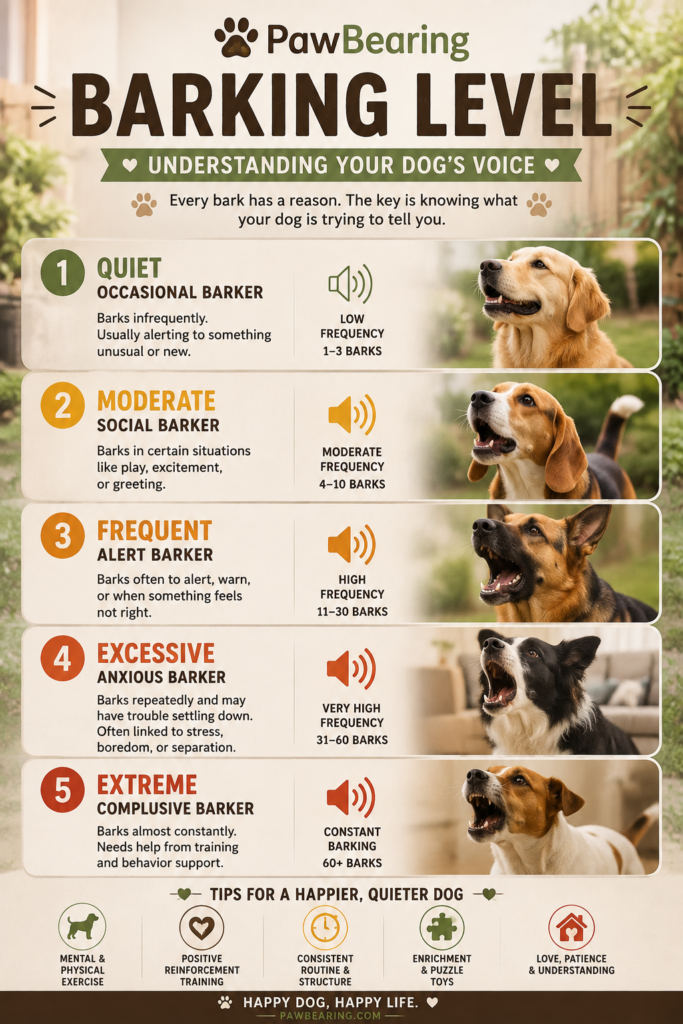
CATEGORY: Barking Level
Few topics in dog ownership generate as much misunderstanding as barking. Ask ten dog owners why dogs bark, and you may receive ten completely different answers. Some believe barking is always a sign of aggression. Others think barking simply means a dog is badly trained. Some assume small dogs bark more because they are nervous, while others believe certain training methods can completely eliminate barking forever.
The reality is far more interesting.
Barking is one of the most complex forms of canine communication. It is influenced by genetics, breed history, personality, early socialisation, environment, health, emotional state, learning, and daily experiences. No single explanation applies to every dog or every situation.
Unfortunately, many popular myths continue to circulate online and through word of mouth. These misconceptions often lead owners to use ineffective training methods, misunderstand their dog’s behaviour, or develop unrealistic expectations about what a “well-behaved” dog should be.
Understanding the truth behind these myths allows owners to make better decisions. Instead of reacting emotionally to barking, they can interpret it more accurately, respond appropriately, and build stronger relationships with their dogs. In many cases, simply changing the way we think about barking dramatically changes the way we approach training.
This article explores some of the most common myths surrounding dog barking and explains what modern canine behaviour research and experienced trainers have learned about this natural behaviour.
Myth 1: A Good Dog Never Barks
Perhaps the most widespread misconception is that a well-trained dog should remain silent.
This simply is not true.
Barking is one of the primary ways dogs communicate.
Healthy dogs naturally bark when:
- Someone approaches the house.
- They become excited.
- They feel uncertain.
- They want attention.
- They are playing.
- They detect something unusual.
Training should never aim to eliminate barking completely.
Instead, owners should teach dogs when barking is appropriate and how to settle once the message has been communicated.
A dog that never barks at all may actually be unwell, unusually fearful, or simply belong to a naturally quiet breed.
Myth 2: Barking Always Means Aggression
Many people become nervous whenever they hear a barking dog.
While barking can accompany aggressive behaviour, it is far from the only explanation.
Dogs also bark because they are:
- Happy.
- Excited.
- Curious.
- Frightened.
- Frustrated.
- Lonely.
- Playful.
The bark itself provides only part of the information.
Owners should also observe:
- Tail position.
- Ear position.
- Facial expression.
- Body posture.
- Movement.
- The surrounding situation.
Looking at the whole dog provides a far more accurate understanding than listening to the bark alone.
Myth 3: Small Dogs Bark More Simply Because They Are Small
Body size has very little to do with barking frequency.
Breed history is usually far more important.
Many small breeds were originally developed as watchdogs, where quick vocal warnings were highly valued.
Likewise, several very large breeds are naturally calm and relatively quiet indoors.
Examples include Greyhounds and Great Danes, which often bark less than many toy breeds.
Choosing a dog based only on size can therefore lead to unrealistic expectations.
Myth 4: Barking Can Be Stopped Instantly
Owners sometimes expect a single training session, command, or product to solve barking immediately.
Behaviour rarely works that way.
Dogs develop barking habits through repeated experiences.
Changing those habits also requires repetition.
Successful training involves:
- Consistency.
- Patience.
- Understanding triggers.
- Rewarding calm behaviour.
- Meeting physical and mental needs.
There is no universal shortcut that permanently stops barking overnight.
Myth 5: Shouting Makes Dogs Understand
When a dog barks repeatedly, many people instinctively raise their own voice.
Ironically, the dog may interpret this as joining the barking rather than stopping it.
From the dog’s perspective, everyone appears to be participating in the excitement.
Calm, consistent responses generally produce much better results than shouting.
Dogs learn more effectively from clear guidance than emotional reactions.
Myth 6: Older Dogs Cannot Learn Better Barking Habits
While puppies often learn new behaviours more quickly, adult dogs remain highly capable of learning.
With appropriate motivation and consistent training, many older dogs successfully develop calmer responses to common triggers.
Changing behaviour may require more patience if barking has been practised for many years, but improvement remains entirely possible.
The saying “you can’t teach an old dog new tricks” is simply inaccurate.
Myth 7: Barking Is Always a Training Problem
Training certainly influences barking, but it is not always the underlying cause.
Medical issues, pain, hearing changes, anxiety, fear, boredom, and environmental stress can all increase barking.
A dog that suddenly begins barking far more than usual may require veterinary assessment before behavioural training alone.
Understanding the reason behind the behaviour is always the first priority.
Myth 8: Certain Breeds Never Bark
Every breed is capable of barking.
Some breeds simply bark less frequently than others.
Even famously quiet breeds will usually bark when:
- Startled.
- Protecting their family.
- Playing.
- Feeling threatened.
- Communicating excitement.
Low barking does not mean silent.
Likewise, naturally vocal breeds can still learn excellent self-control through training.
Myth 9: Bark Collars Solve the Real Problem
Anti-bark devices may interrupt barking temporarily, but they do not explain why the dog is barking.
If the underlying cause remains:
- Fear.
- Boredom.
- Anxiety.
- Frustration.
- Lack of exercise.
the emotional problem still exists.
Addressing the root cause generally produces far more reliable and humane long-term results than simply suppressing the symptom.
Myth 10: Understanding Barking Makes You a Better Owner
This final statement is not a myth—it is one of the most valuable lessons in dog ownership.
Owners who understand canine communication tend to respond more calmly and more effectively.
Instead of asking:
“How do I stop my dog barking?”
they begin asking:
“What is my dog trying to tell me?”
That single change in perspective often transforms the relationship between dog and owner.
Communication replaces conflict.
Understanding replaces frustration.
Training becomes far more successful because it addresses the dog’s actual needs rather than simply reacting to the sound.
Final Thoughts
Dog barking is surrounded by myths that often create unrealistic expectations and unnecessary frustration for owners. The truth is that barking is a natural, healthy form of canine communication shaped by breed history, genetics, personality, environment, learning, and emotional wellbeing. Understanding these influences allows owners to respond thoughtfully instead of relying on outdated assumptions or quick fixes that fail to address the real causes of barking.
Successful dog ownership begins with education and patience. Rather than trying to eliminate barking entirely, responsible owners learn to interpret what their dogs are communicating and guide them toward appropriate behaviour through positive training, consistency, exercise, mental stimulation, and trust. When myths are replaced by knowledge, barking becomes far easier to understand, training becomes more effective, and the relationship between owner and dog grows stronger, calmer, and far more rewarding.
The End
PawBearing
 Discover More From Our Family of Websites
 ZodiacBearing (Astrology, Tarot, Numerology, Angel Numbers & Spiritual Guidance)
 Velourana (Beauty, Makeup, Hair Care, Skincare & Beauty Tips)
 HavenBearing (Home, Living, Organization, Décor & Everyday Inspiration)
 PawBearing (Pet Care, Dog Breeds, Animal Health, Training & Pet Products)
 PsyCatherine (Notes From the Journal of a Psychologist on Real Life)