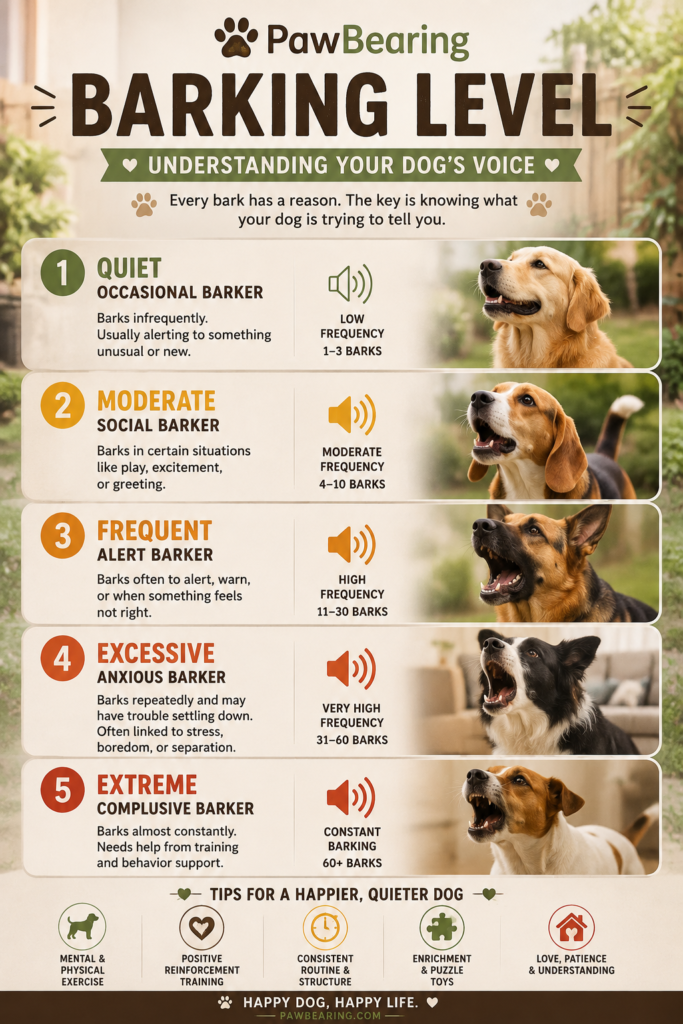
CATEGORY: Barking Level
When choosing a dog, many people focus on appearance, size, coat type, or energy level. While these characteristics are certainly important, one trait that often has an even greater impact on daily life is barking level. A dog’s tendency to bark can influence relationships with neighbours, apartment living, training requirements, household noise, and even stress levels within the family.
Contrary to popular belief, barking is not simply a bad habit. It is one of the primary ways dogs communicate. Through barking they express excitement, fear, boredom, frustration, alertness, happiness, loneliness, and even physical discomfort. Understanding why dogs bark—and why some breeds naturally vocalise more than others—helps owners choose companions that suit their lifestyle while encouraging healthy communication rather than attempting to eliminate barking entirely.
Some breeds were developed specifically to alert people to approaching strangers or unusual activity. Others were bred to work independently over long distances, using their voice to communicate with hunters or livestock handlers. Meanwhile, many companion breeds tend to bark only occasionally, making them better suited to quieter environments.
Learning about barking levels before bringing a dog home is therefore one of the most valuable steps any prospective owner can take. A breed’s natural vocal tendencies cannot be completely changed through training, but they can certainly be managed and understood.
Why Dogs Bark
Barking is a natural behaviour rather than a behavioural problem.
Dogs use vocalisation for many different reasons.
Some of the most common include:
- Alerting their family to unfamiliar people.
- Expressing excitement.
- Seeking attention.
- Responding to other dogs.
- Communicating fear or uncertainty.
- Protecting territory.
- Relieving boredom.
- Reacting to unusual sounds.
The meaning behind barking depends heavily on the situation, body language, and the individual dog’s personality.
A confident bark directed at a stranger outside the house communicates something very different from repeated barking caused by loneliness or anxiety.
Low, Moderate, and High Barking Levels
Many breed guides describe barking using three general categories.
Low barking breeds vocalise only occasionally.
They may bark when genuinely necessary but spend much of their day quietly observing their surroundings.
Moderate barking breeds communicate regularly without becoming excessively noisy.
They often alert owners when something unusual happens but settle quickly once reassured.
High barking breeds naturally vocalise much more frequently.
These breeds may bark while playing, greeting people, hearing outside noises, protecting territory, or responding to excitement.
High barking levels are not signs of poor behaviour.
They are often deeply connected to the breed’s historical working purpose.
Genetics Play an Important Role
One reason barking varies so dramatically between breeds is selective breeding.
Over hundreds of years, humans encouraged certain behaviours that supported different types of work.
Examples include:
Herding dogs that needed to control livestock.
Terriers that announced activity underground.
Hounds that communicated with hunters across long distances.
Guard dogs that warned of approaching strangers.
Companion breeds that remained relatively quiet indoors.
Although every individual dog has its own personality, breed history often provides a strong indication of natural barking tendencies.
Understanding this background helps set realistic expectations.
Environment Influences Barking
Even naturally quiet breeds may bark frequently if their environment encourages it.
Several factors can increase vocal behaviour.
These include:
- Lack of exercise.
- Insufficient mental stimulation.
- Long periods alone.
- Constant outside noise.
- Poor socialisation.
- Inconsistent training.
- Anxiety.
- Territorial behaviour.
Conversely, many naturally vocal breeds become considerably quieter when their physical and emotional needs are consistently met.
Daily routines therefore play an important role alongside genetics.
Living Situation Matters
Where you live should influence the type of barking level you are prepared to manage.
Apartment living generally benefits from breeds with lower or moderate barking tendencies.
Detached homes with large gardens usually provide greater flexibility.
People living in busy urban environments may encounter frequent external triggers such as:
- Passing pedestrians.
- Delivery drivers.
- Traffic.
- Other dogs.
- Neighbours.
- Construction work.
These constant stimuli can encourage barking if dogs are not properly trained or mentally occupied.
Choosing a breed compatible with your living environment helps create a happier experience for both owner and dog.
Can Barking Be Reduced?
Training cannot completely remove natural communication, nor should it.
However, owners can teach dogs when barking is appropriate and when calm behaviour is rewarded.
Helpful approaches include:
- Early socialisation.
- Positive reinforcement.
- Providing sufficient exercise.
- Mental enrichment.
- Predictable routines.
- Avoiding boredom.
- Teaching alternative behaviours.
Punishing barking without understanding its cause often increases confusion or anxiety rather than solving the underlying issue.
Successful training begins by identifying why the dog is barking in the first place.
Common Causes of Excessive Barking
Occasional barking is entirely normal.
Persistent or excessive barking may indicate that something requires attention.
Possible causes include:
- Separation anxiety.
- Lack of physical activity.
- Loneliness.
- Fear.
- Medical discomfort.
- Territorial behaviour.
- Frustration.
- Attention-seeking.
Observing when barking occurs often provides valuable clues.
A dog that barks only when left alone requires a different approach from one that reacts whenever someone walks past the front gate.
Barking Is Part of Communication
Many first-time owners hope their dog will remain almost completely silent.
In reality, barking forms an important part of canine communication.
Dogs also communicate through:
- Body posture.
- Tail position.
- Facial expressions.
- Ear movement.
- Eye contact.
- Vocal sounds.
Learning to interpret these signals helps owners respond appropriately instead of focusing only on the barking itself.
Communication strengthens the relationship between people and their dogs.
Choosing the Right Breed for Your Lifestyle
Perhaps the most important lesson is that there is no universally “best” barking level.
Some owners appreciate highly alert dogs that immediately announce visitors.
Others prefer quieter companions suited to apartment living or peaceful neighbourhoods.
Before selecting a breed, consider:
- Your home’s location.
- Local noise restrictions.
- Family lifestyle.
- Available training time.
- Daily exercise routine.
- Experience with dogs.
Matching a dog’s natural vocal tendencies to your expectations creates a far more successful partnership than attempting to change deeply rooted breed characteristics later.
Final Thoughts
A dog’s barking level is an important characteristic that deserves careful consideration before choosing a breed. Barking is not simply noise—it is a natural form of communication shaped by genetics, history, environment, training, and individual personality. While some breeds are naturally quiet and reserved, others have been developed over centuries to use their voice as part of their working role. Understanding these differences allows prospective owners to make informed decisions based on their lifestyle rather than appearance alone.
Successful dog ownership is not about preventing barking altogether but about understanding why it occurs and managing it appropriately. With proper socialisation, positive training, regular exercise, mental stimulation, and realistic expectations, most dogs learn when barking is appropriate while remaining confident and emotionally healthy. Choosing a breed whose natural barking level matches your living environment and personal preferences is one of the best ways to build a happy, long-lasting relationship with your canine companion.
The End
PawBearing
 Discover More From Our Family of Websites
 ZodiacBearing (Astrology, Tarot, Numerology, Angel Numbers & Spiritual Guidance)
 Velourana (Beauty, Makeup, Hair Care, Skincare & Beauty Tips)
 HavenBearing (Home, Living, Organization, Décor & Everyday Inspiration)
 PawBearing (Pet Care, Dog Breeds, Animal Health, Training & Pet Products)
 PsyCatherine (Notes From the Journal of a Psychologist on Real Life)