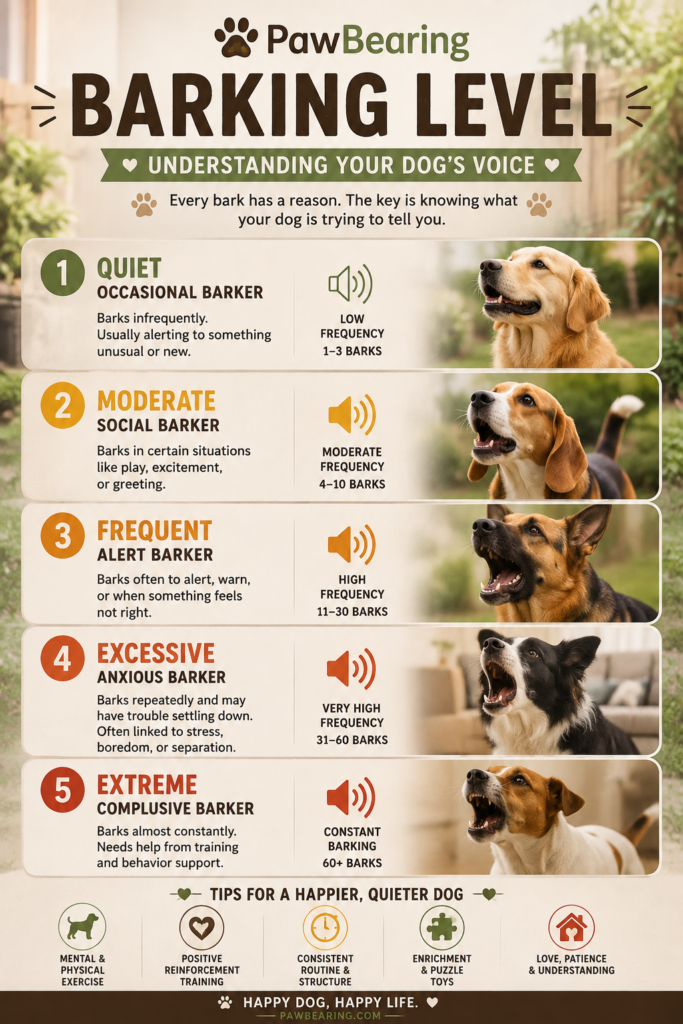
CATEGORY: Barking Level
Almost every dog barks. It is one of the most natural forms of canine communication and serves many important purposes throughout a dog’s life. A bark may warn about approaching strangers, express excitement, invite play, signal fear, communicate frustration, or simply attract attention. Occasional barking is completely normal and should not be viewed as a behavioural problem.
Excessive barking, however, is different.
When barking becomes constant, repetitive, or difficult to interrupt, it can place strain on the relationship between dog and owner. It may also create difficulties with neighbours, increase household stress, and sometimes indicate that the dog is struggling emotionally or physically.
One of the biggest mistakes owners make is treating excessive barking as the problem itself. In reality, barking is usually a symptom rather than the underlying issue. The real question is not “How do I stop my dog barking?” but rather “Why is my dog barking so much?”
Finding the answer requires careful observation. Dogs rarely bark continuously without a reason. Whether that reason is boredom, anxiety, loneliness, frustration, territorial behaviour, lack of exercise, or even physical discomfort, identifying the cause is the first and most important step toward resolving the behaviour in a humane and lasting way.
Understanding the motivation behind barking allows owners to work with their dog instead of against it, creating a calmer household while strengthening trust and communication.
What Counts as Excessive Barking?
There is no universal definition.
A dog that barks enthusiastically during a short game is behaving normally.
Likewise, a few alert barks when someone knocks on the door are entirely natural.
Excessive barking generally refers to vocalisation that:
- Continues for long periods.
- Happens repeatedly without obvious reason.
- Becomes difficult to interrupt.
- Creates distress for the dog or family.
- Causes problems with neighbours.
Context always matters.
Frequency alone does not determine whether barking has become excessive.
The Most Common Causes
Dogs bark for many different reasons.
Understanding these causes is essential because each requires a different solution.
Some of the most common include:
- Boredom.
- Loneliness.
- Separation anxiety.
- Fear.
- Territorial behaviour.
- Frustration.
- Excitement.
- Attention-seeking.
- Medical discomfort.
- Environmental triggers.
A dog barking because it is frightened needs a completely different approach from one barking because it lacks exercise.
Treating every barking problem in the same way rarely produces lasting success.
Boredom Is More Common Than Many Owners Realise
Dogs are intelligent animals that require both physical activity and mental stimulation.
When these needs are not met, barking often becomes a form of self-entertainment.
A bored dog may also:
- Pace.
- Dig.
- Chew furniture.
- Chase shadows.
- Constantly seek attention.
Simply telling the dog to be quiet does not remove the underlying boredom.
Instead, increasing enrichment often produces remarkable improvements.
Useful activities include:
- Longer walks.
- Puzzle feeders.
- Scent games.
- Training sessions.
- Interactive toys.
A mentally occupied dog is usually a much quieter dog.
Separation-Related Barking
Some dogs bark only when left alone.
Owners may never witness this behaviour directly unless neighbours mention it or cameras reveal what happens after they leave.
Signs often include:
- Continuous barking.
- Howling.
- Scratching doors.
- Restlessness.
- Destructive behaviour.
This may indicate separation-related distress rather than disobedience.
Gradual independence training, predictable routines, and confidence-building exercises are generally more effective than punishment.
Because separation issues vary in severity, patient, structured training is essential.
Territorial Barking
Many dogs believe protecting their home is part of their responsibility.
Passing pedestrians.
Delivery drivers.
Cyclists.
Other dogs.
Wildlife.
These everyday events may all trigger defensive barking.
Closing curtains facing busy streets, managing access to windows, and teaching calm alternative behaviours often reduce these reactions without suppressing the dog’s natural protective instincts.
Fear-Based Barking
Fear frequently causes louder and more persistent barking than excitement.
Dogs may react to:
- Thunderstorms.
- Fireworks.
- Unfamiliar visitors.
- Veterinary clinics.
- Loud machinery.
- Strange environments.
Punishing fearful barking usually increases anxiety because the dog associates additional negative experiences with the frightening situation.
Building confidence through gradual, positive exposure remains a much kinder and more effective approach.
Medical Reasons Should Never Be Ignored
Behaviour sometimes changes because a dog feels physically uncomfortable.
Pain, hearing changes, vision problems, cognitive decline in older dogs, or certain medical conditions may all contribute to increased barking.
If barking suddenly changes without any obvious environmental explanation, particularly in adult or senior dogs, veterinary assessment may be appropriate.
Treating an underlying health problem can sometimes resolve behavioural changes that training alone cannot address.
How Positive Training Helps
Modern dog training focuses on teaching rather than punishing.
Owners often achieve better long-term results by:
Rewarding quiet behaviour.
Teaching a reliable “quiet” cue.
Redirecting attention.
Building confidence.
Creating predictable routines.
Preventing boredom.
Positive reinforcement encourages dogs to repeat calm behaviours because those behaviours consistently lead to rewarding outcomes.
Training becomes a process of communication rather than confrontation.
Mistakes That Often Make Barking Worse
Well-intentioned owners sometimes accidentally reinforce barking.
Common mistakes include:
- Shouting back.
- Giving attention immediately after barking.
- Providing treats simply to stop barking.
- Inconsistent rules.
- Insufficient exercise.
- Ignoring mental stimulation.
Dogs learn through consequences.
If barking regularly produces attention, play, or other desired outcomes, it becomes more likely to occur again.
Consistency is therefore one of the most important elements of successful training.
Creating a Long-Term Solution
Reducing excessive barking rarely happens overnight.
Successful owners usually combine several approaches:
- Identifying triggers.
- Meeting exercise needs.
- Providing enrichment.
- Maintaining routines.
- Rewarding calm behaviour.
- Building confidence.
- Remaining patient.
Over time, many dogs naturally become calmer because the reasons behind their barking gradually disappear.
The goal is not silence but appropriate communication.
Final Thoughts
Excessive barking is rarely a problem in isolation. It is usually a sign that a dog is attempting to communicate an unmet need, emotional response, environmental concern, or physical discomfort. By identifying the underlying cause instead of focusing only on the barking itself, owners can develop solutions that improve both behaviour and overall wellbeing. Whether the issue involves boredom, fear, territorial instincts, separation-related distress, or insufficient exercise, understanding the motivation behind the behaviour is always the first step toward lasting improvement.
Successful training is built on patience, observation, consistency, and positive reinforcement rather than punishment. Dogs that receive appropriate physical activity, mental stimulation, social interaction, and clear guidance generally become more relaxed and confident companions. Rather than trying to eliminate barking completely, responsible owners help their dogs communicate appropriately while creating an environment in which unnecessary barking naturally becomes less frequent. The result is a happier dog, a calmer household, and a stronger relationship based on trust and understanding.
The End
PawBearing
 Discover More From Our Family of Websites
 ZodiacBearing (Astrology, Tarot, Numerology, Angel Numbers & Spiritual Guidance)
 Velourana (Beauty, Makeup, Hair Care, Skincare & Beauty Tips)
 HavenBearing (Home, Living, Organization, Décor & Everyday Inspiration)
 PawBearing (Pet Care, Dog Breeds, Animal Health, Training & Pet Products)
 PsyCatherine (Notes From the Journal of a Psychologist on Real Life)