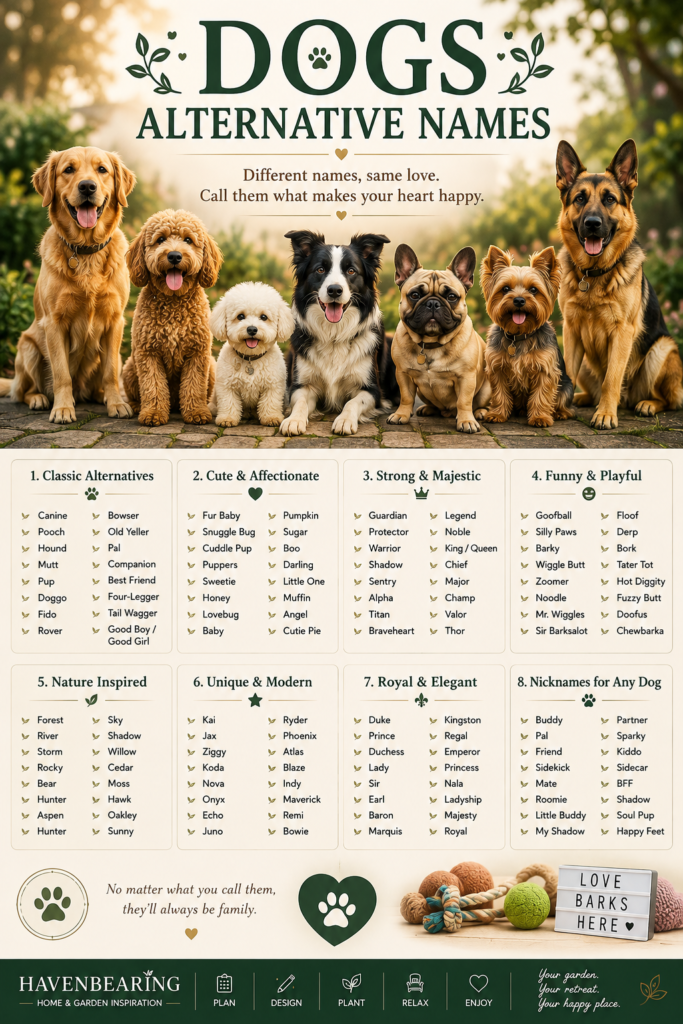
CATEGORY: Alternative Names
Have you ever wondered why English speakers say dog, Germans say Hund, French speakers say chien, Japanese people say inu, and Italians say cane? Every language has its own word for one of humanity’s oldest companions, yet very few people stop to consider where these names actually came from.
Language is never created overnight. Words develop gradually over centuries as communities grow, migrate, trade, and interact with one another. The names used for dogs are no exception. Some can be traced back thousands of years to ancient civilizations, while others have changed dramatically as languages evolved. A few modern words remain remarkably close to their ancient ancestors, while others have taken completely different paths.
The history of canine terminology is closely connected to the history of human civilization itself. As people domesticated wolves, settled into farming communities, developed new languages, and spread across continents, the words they used for dogs evolved alongside them.
Understanding this linguistic journey offers far more than interesting trivia. It provides insight into human migration, cultural exchange, and the extraordinary relationship between people and dogs that has existed for many thousands of years.
Before Dogs Had Names
Long before written language existed, humans almost certainly communicated using sounds, gestures, and simple spoken expressions.
Archaeological evidence suggests that wolves began forming relationships with humans at least 15,000 years ago, and possibly much earlier.
During these early periods there were no dictionaries, alphabets, or formal grammar.
Instead, communities naturally developed sounds that gradually became meaningful words.
Because early human groups were separated by mountains, forests, deserts, and oceans, each community eventually created its own vocabulary.
This explains why modern languages contain such different words for the same animal despite sharing similar histories of domestication.
The Ancient Latin Word: Canis
One of the most influential dog names in history comes from ancient Rome.
The Latin word Canis simply meant “dog.”
Although Latin is no longer spoken as an everyday language, its influence remains enormous.
Modern scientific classification still uses Canis lupus familiaris for the domestic dog.
Words such as:
Canine
Canid
Canis
all derive directly from this ancient Latin root.
Many Romance languages also preserve traces of Latin vocabulary, demonstrating how powerful Roman influence remained throughout Europe for centuries.
Ancient Greek Contributions
The ancient Greeks used the word Kyon (sometimes written Kuon in English transliteration).
Although this word differs from Latin Canis, it belongs to the wider Indo-European language family.
Greek mythology also contributed famous canine names such as Cerberus, the guardian of the Underworld.
Ancient Greek scholars wrote extensively about hunting dogs, shepherd dogs, and war dogs, helping preserve important descriptions of canine life thousands of years ago.
These writings continue influencing historians and linguists today.
The Germanic Languages
Across northern Europe, Germanic peoples developed their own terminology.
The ancient root eventually produced words including:
Hund (German)
Hund (Danish)
Hund (Norwegian)
Hund (Swedish)
Hond (Dutch)
Hundur (Icelandic)
Interestingly, Old English originally relied much more heavily on the word hound than on dog.
In earlier centuries, hound simply meant dog.
Only later did English narrow its meaning to describe hunting breeds while adopting dog as the general everyday word.
This unusual shift makes English rather different from its closest linguistic relatives.
Why English Uses “Dog”
The origin of the English word dog remains one of the language’s great mysteries.
Unlike many other common animal names, scholars have not reached complete agreement regarding its earliest source.
Some believe it developed from an older regional dialect.
Others suggest it gradually replaced earlier terminology through everyday use.
Whatever its exact origin, the word became increasingly popular during the Middle Ages until it eventually replaced hound as the standard English term.
Today it is difficult to imagine English using any other word, yet history shows that language is constantly evolving.
Dog Names in Asia Developed Independently
While European languages often share ancient roots, many Asian languages developed independently.
Japanese uses Inu.
Mandarin Chinese uses Gǒu.
Korean uses Gae.
Thai uses Maa.
Vietnamese uses Chó.
These words arose within completely different linguistic traditions shaped by unique histories and cultures.
Although they sound unrelated to European terminology, they reflect equally ancient relationships between humans and dogs.
The remarkable diversity demonstrates how widespread dog domestication became across the world.
Human Migration Changed Language
As humans travelled, traded, conquered territories, and established new settlements, languages constantly influenced one another.
Some words were borrowed directly.
Others gradually changed pronunciation over generations.
Sometimes one language replaced another entirely.
Dogs travelled alongside humans during these migrations, meaning their names also evolved.
The result is a fascinating network of related and unrelated words that linguists continue studying today.
Every modern dog name reflects countless generations of cultural change.
Scientific Classification Unified Terminology
Although everyday language varies enormously, science introduced greater consistency.
Modern biological classification places domestic dogs within the genus Canis.
This allows researchers from different countries to communicate accurately regardless of their native language.
A veterinarian in Japan, Brazil, Germany, or South Africa may use different everyday words for dogs, but scientific terminology remains internationally recognised.
This balance between local language and global science helps preserve both cultural diversity and precise communication.
Why These Different Names Matter
At first glance, learning where dog names came from may seem like little more than historical curiosity.
In reality, these words reveal extraordinary stories about humanity itself.
They trace ancient migrations.
They preserve forgotten civilizations.
They demonstrate how cultures interacted.
They remind us that dogs accompanied humans through nearly every stage of recorded history.
Every language tells part of that shared story.
Understanding these names encourages greater appreciation not only for dogs but also for the remarkable development of human communication.
Final Thoughts
The many names used for dogs around the world are far more than simple vocabulary. They represent thousands of years of language, migration, culture, and companionship between humans and one of the first animals ever domesticated. From the ancient Latin Canis and Greek Kyon to the English dog, German Hund, Japanese Inu, and countless others, each word reflects a unique chapter in the history of civilization.
Perhaps the most remarkable lesson is that while languages continue changing, the bond between humans and dogs has remained remarkably constant. Every culture developed its own name, but every culture also recognised the same qualities—loyalty, intelligence, protection, and companionship. The words may differ across continents, yet they all celebrate the extraordinary relationship that has connected people and dogs for thousands of years.
The End
PawBearing
 Discover More From Our Family of Websites
 ZodiacBearing (Astrology, Tarot, Numerology, Angel Numbers & Spiritual Guidance)
 Velourana (Beauty, Makeup, Hair Care, Skincare & Beauty Tips)
 HavenBearing (Home, Living, Organization, Décor & Everyday Inspiration)
 PawBearing (Pet Care, Dog Breeds, Animal Health, Training & Pet Products)
 PsyCatherine (Notes From the Journal of a Psychologist on Real Life)