CATEGORY: Chasing instinct
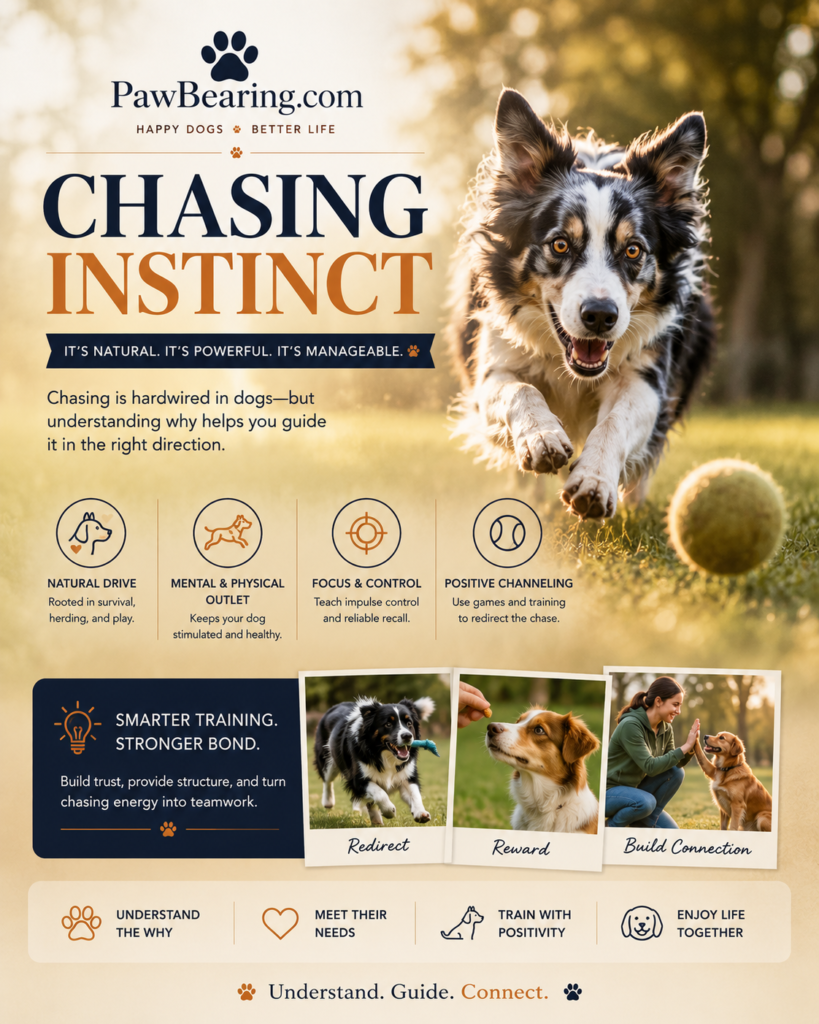
Reducing chasing behavior in dogs is rarely about eliminating interest in movement completely.
For many dogs, movement is naturally important. A rabbit running across a field, a bicycle passing on the road, a child sprinting through a garden, or a ball rolling across the floor can trigger immediate attention. In some dogs, that attention remains mild. In others, it develops rapidly into fixation, pulling, lunging, or full pursuit.
The practical goal is not to make the dog blind to movement.
It is to help the dog notice a trigger without automatically being controlled by it.
That distinction changes the entire approach to training.
A dog that is taught only after it has already begun chasing is being asked to respond at the hardest possible moment. A dog that learns to disengage before the chase begins has a much greater chance of success.
This is why effective chasing-control training focuses on timing, distance, repetition, alternative behaviors, reinforcement, and physical management.
The strongest results usually come from combining all of these rather than relying on a single command.
Start With Prevention, Not Correction
The more often a dog practices chasing, the stronger and more automatic the behavior can become.
A dog that repeatedly chases squirrels in the garden gets better at noticing squirrels.
A dog that runs along the fence after bicycles becomes more vigilant for bicycles.
A dog that frequently pursues other dogs in open spaces may begin reacting sooner and with greater intensity.
This means prevention is not separate from training.
It is part of training.
Every prevented chase is one less repetition of the unwanted behavior.
Every successful disengagement is one repetition of the behavior you actually want.
Management Buys Training Time
Management means arranging the environment so the dog cannot keep rehearsing the problem.
This may include:
Secure fencing.
Lead use.
Long-line walking.
Avoiding high-trigger areas temporarily.
Blocking visual access to roads or paths.
Reducing access to windows.
Choosing quieter walking times.
Using gates or barriers inside the home.
These measures do not teach the final behavior by themselves.
They create enough control for training to work.
A Secure Lead Is Not a Training Failure
Owners sometimes feel they should be able to “trust” the dog off lead if training is successful.
That expectation can create unnecessary risk.
A dog with strong chasing instinct may remain safer on lead or long line in wildlife-rich areas.
This does not mean training failed.
It means the owner is making a realistic safety decision.
Training improves behavior.
Management prevents catastrophe when training is tested by something stronger than expected.
Learn the Dog’s Early Warning Signs
The chase usually begins before the legs move.
Look for:
The head lifting suddenly.
Mouth closing.
Body becoming still.
Eyes locking onto movement.
Ears changing position.
Weight shifting forward.
Sniffing stopping.
The dog leaning toward the target.
These signs may appear only for a second or two.
That moment is extremely valuable.
Intervening here is much easier than trying to stop full-speed pursuit.
Fixation Should Be Interrupted Early
A dog staring intensely at a target may appear calm because it is not moving.
But prolonged fixation often increases the probability of pursuit.
The dog is becoming more committed.
This is why allowing the dog to stare for several seconds and then issuing a recall can make training unnecessarily difficult.
Interrupt earlier.
Call the dog.
Move away.
Reward attention.
Create distance.
The best interruption often happens before the dog looks visibly excited.
Distance Is One of the Most Powerful Training Tools
Many owners try to train too close to the trigger.
If the dog starts lunging when a bicycle passes at five metres, then five metres is probably too close for early training.
Move farther away.
At twenty metres, the dog may notice the bicycle but still be able to respond.
That is the useful training zone.
The goal is to work where the dog can succeed.
Distance is not avoidance.
It is difficulty control.
Find the Working Distance
Every dog has a different threshold.
One dog may remain calm around runners at ten metres.
Another may need forty.
One dog may ignore a rabbit far away.
Another may become highly focused as soon as it sees one.
The correct training distance is the point where the dog notices the trigger but can still:
Respond to its name.
Take food.
Look back at the handler.
Move away.
Perform a simple known behavior.
If those abilities disappear, increase distance.
The Working Distance Changes Over Time
The same dog may need different distances on different days.
Stress.
Fatigue.
Previous excitement.
Environment.
Weather.
Number of triggers.
All can influence responsiveness.
Do not turn training into a rigid test.
Adjust according to the dog standing in front of you that day.
Teach a Strong Attention Cue
A dog that can orient quickly toward the handler has an alternative response to fixation.
This can be trained very simply.
Say the dog’s name.
The dog looks at you.
Reward.
Repeat in easy environments.
Then add mild distractions.
Eventually, practice outdoors.
The aim is not to force constant eye contact.
It is to create a reliable way of bringing attention back.
Hand Targeting Can Be Useful
A hand target is another practical behavior.
Present your hand.
The dog touches it with its nose.
Reward.
This gives the dog a physical action that turns the head away from the trigger.
It can be particularly useful when you need to move the dog in a specific direction.
Instead of arguing with fixation, you give the dog something clear and familiar to do.
Teach a Moving Away Cue
Sometimes the best response is simply leaving.
A cue such as “this way” can be trained to mean:
Turn with me.
Move away quickly.
Reward.
Practice first when nothing exciting is happening.
Change direction.
Reward the dog for following.
Once this becomes automatic, it can be used around triggers before fixation becomes intense.
Recall Should Be Built Gradually
Recall is important, but it should not be tested at maximum difficulty too early.
Start indoors.
Then garden.
Then quiet outdoor areas.
Then long-line work.
Then mild movement.
Then more challenging distractions.
Each successful level creates a stronger history.
The dog should not be expected to recall from wildlife simply because it comes when called in the kitchen.
Protect the Recall Cue
Do not repeatedly call the dog when you already know it is unlikely to respond.
Every ignored recall weakens the practical meaning of the cue.
Instead, use the lead or long line to prevent failure.
Call when success is realistic.
Reward generously.
Then release the dog back to safe exploration when appropriate.
The cue should predict something worthwhile.
Build an Emergency Recall Separately
An emergency recall can provide another layer of safety.
Use a distinct cue.
Associate it with exceptionally valuable reinforcement.
Practice in controlled environments.
Use it rarely.
Do not turn it into an everyday word.
The goal is to create a cue with a very strong reinforcement history.
It is not a substitute for management, but it can be valuable.
Reward Disengagement Before Recall
One of the most useful behaviors is spontaneous disengagement.
The dog sees a squirrel.
Looks.
Then looks back at you.
Reward immediately.
The dog notices a bicycle.
Then turns away.
Reward.
This teaches the dog that breaking visual contact is valuable.
Over time, the dog may begin offering the behavior more frequently.
That is often more useful than waiting until the dog is fully focused and then calling.
Use the Trigger as Information
The trigger does not need to disappear from the environment for learning to occur.
The dog can see it.
The important question is whether the dog remains able to choose another response.
This turns real-world movement into a training opportunity.
The trigger appears.
The dog notices.
The dog disengages.
Reward.
That sequence can gradually replace:
Trigger appears.
Dog fixates.
Dog chases.
High-Value Reinforcement Matters
A piece of ordinary kibble may be sufficient in the kitchen.
It may be meaningless when a rabbit appears.
Use rewards that genuinely matter to the individual dog.
Food.
Toy.
Tug.
Permission to sniff.
Access to movement.
The stronger the distraction, the more valuable the reinforcement may need to be.
Training should compete realistically with the environment.
Not Every Dog Works Best for Food
Some dogs are extremely toy motivated.
A chase-driven dog may value a tug or moving toy more than food.
This can be used strategically.
The dog disengages from a moving trigger.
Then receives a controlled toy chase.
The handler turns the dog’s natural motivation into reinforcement.
The dog learns that responding to the owner can lead to an appropriate version of the behavior it enjoys.
Reward Timing Should Be Precise
Reward after the behavior you want.
Look away from trigger.
Reward.
Turn toward handler.
Reward.
Come when called.
Reward.
Walk calmly past.
Reward.
The closer the reward follows the correct behavior, the easier it is for the dog to understand the pattern.
Late reinforcement can make training less clear.
Do Not Reward Prolonged Fixation Accidentally
If the dog stares at a squirrel for twenty seconds and then receives food while still staring, the owner may not be reinforcing disengagement.
The dog may simply be eating while maintaining fixation.
Wait for an actual break in attention.
Even a brief glance away can be the first success.
Mark and reward that moment.
Use Movement Carefully
Standing still while the dog fixates can make the situation harder.
Sometimes moving away helps.
Create lateral distance.
Turn.
Walk in an arc.
Use a hand target.
Movement gives the dog something else to follow.
It also increases physical distance from the trigger.
Avoid Tight Lead Battles
A dog pulling hard toward a target while the owner pulls hard in the opposite direction can create a prolonged physical struggle.
This often keeps both dog and handler focused on the trigger.
Whenever possible, intervene earlier.
Use distance.
Change direction.
Keep the lead secure but avoid unnecessary tension.
The objective is not to overpower the dog physically.
It is to prevent escalation and create conditions for learning.
Long Lines Give Controlled Freedom
A long line can be extremely useful for chase-control training.
The dog can explore and move naturally while remaining physically connected.
This creates opportunities to practice recall and disengagement in real outdoor environments.
A long line should be used carefully.
Avoid wrapping it around hands.
Watch for tangles.
Prevent high-speed impact at the end of the line.
A suitable harness can reduce sudden force on the neck.
Harness Fit Matters
Dogs attempting to chase can generate strong forward force.
A poorly fitted harness may twist or allow escape.
The equipment should fit securely without restricting normal movement.
Owners should check straps, clips, and wear regularly.
Training equipment is only useful if it remains reliable under sudden pressure.
Practice With Controlled Moving Triggers
Real wildlife is unpredictable.
Controlled triggers are easier.
A friend walking.
Then jogging.
A bicycle moving slowly at a distance.
A ball rolling under handler control.
This allows the owner to adjust speed, distance, and repetition.
The dog can learn under manageable conditions before confronting harder real-world movement.
Increase Only One Difficulty at a Time
Training becomes clearer when one variable changes at a time.
Do not simultaneously:
Reduce distance.
Increase speed.
Increase noise.
Change location.
Add several triggers.
Instead:
Keep distance large and increase movement slightly.
Or keep movement slow and reduce distance slightly.
This makes it easier to identify what the dog can handle.
Short Successful Sessions Work Better Than Long Failing Ones
A few successful repetitions can be more valuable than twenty minutes of escalating frustration.
Stop while the dog is still capable of learning.
Move away.
Let the dog sniff.
End the session.
Training quality matters more than duration.
Use Pattern Games
Predictable sequences can help dogs cope with movement.
For example:
One-two-three, reward.
Walk several steps.
Reward at a predictable point.
Turn.
Reward.
Simple patterns reduce uncertainty and give the dog something familiar to follow when the environment is stimulating.
They can be especially useful around repeated triggers such as bicycles or runners.
Scatter Feeding Can Help Some Dogs
If the dog can still eat, scattering several small food pieces on the ground can shift attention downward.
Sniffing for food competes with visual fixation.
This can create a useful reset.
However, it should not be used when the dog is already too aroused to eat.
In that case, increase distance first.
Sniffing Is More Than Distraction
Sniffing can help balance dogs that spend much of the walk visually scanning for movement.
Allow time for slow exploration.
Let the dog investigate scent.
Use food searches.
Hide treats.
Create scent trails.
These activities engage a different behavioral system and can reduce the walk’s emphasis on pursuit.
Walks Should Not Be Constant Obedience Tests
A dog with chasing instinct still needs normal dog behavior.
Sniffing.
Exploration.
Movement.
Choice.
The owner does not need to demand perfect heelwork for the entire walk.
Instead, teach the dog to shift between freedom and control.
Explore when safe.
Reconnect when needed.
Pass the trigger.
Return to exploration.
Controlled Chase Games Can Help Channel Instinct
Safe chasing activities can provide an appropriate outlet.
Retrieve games.
Flirt-pole play.
Moving tug toys.
Structured ball games.
The important word is controlled.
The dog should not simply launch whenever something moves.
The game should have rules.
Teach a Start Cue for Chasing Games
Ask the dog to wait briefly.
Move the toy.
Release the dog.
Now the chase begins.
The dog learns:
Movement alone does not release me.
Permission does.
This is useful impulse-control practice embedded inside a highly rewarding activity.
Teach a Stop Cue Too
The game also needs an ending.
Release the toy.
Come back.
Settle.
Switch to sniffing.
Without clear transitions, some dogs remain highly aroused after play.
Training should include coming down from excitement, not only building it.
Avoid Endless Ball Throwing
Ball chasing can be enjoyable, but repeated high-speed throwing for long periods can create intense fixation in some dogs.
The dog may stop sniffing.
Stop exploring.
Watch the owner constantly.
Demand more throws.
Use ball play strategically rather than making it the entire walk.
Mix in searching, recall, walking, and rest.
Use Search Games With Toys
Instead of always throwing the toy visibly, hide it.
Let the dog search.
This turns the activity from pure visual pursuit into a combination of scent and problem-solving.
It can be especially useful for dogs that become overly focused on movement.
Chasing Other Dogs Needs Social Management
If the dog chases other dogs excessively, do not assume more dog-park exposure will automatically fix the behavior.
Choose appropriate play partners.
Monitor whether the other dog is comfortable.
Interrupt one-sided chasing.
Create pauses.
Reward calm re-engagement.
Healthy play should contain flexibility.
Interrupt Play Before It Escalates
Call the dog away briefly.
Reward.
Allow a short pause.
If both dogs remain relaxed and want to continue, release again.
This builds the dog’s ability to leave exciting social interaction and return.
It also prevents chasing from escalating unchecked.
Chasing Children Requires Strict Prevention
Do not use children as moving training props.
If a dog chases running children, manage the environment carefully.
Use barriers.
Lead control.
Structured adult-led training.
Teach the dog alternative behaviors around calm movement first.
The risk of knocking a child over or nipping moving legs is too high for casual experimentation.
Teach Around Runners Gradually
Begin at distance.
The runner walks.
Then moves slightly faster.
Reward calm attention.
Gradually reduce distance or increase speed.
The dog should succeed at each level before difficulty rises.
This is much more effective than repeatedly exposing the dog to runners at close range until it “gets used to it.”
Bicycle Training Should Be Controlled
Bicycles are difficult because they move quickly and can create safety risks.
Use a controlled setup if possible.
Stationary bicycle first.
Then slow movement at distance.
Reward calm behavior.
Increase speed gradually.
Real-world cyclists should not be expected to participate in training.
The owner should manage distance.
Car Chasing Requires Hard Safety Boundaries
Car chasing is too dangerous for casual exposure.
Secure fencing.
Lead control.
No uncontrolled roadside access.
Training can focus on calm observation from safe distance, but management must remain strong.
A dog should never be given freedom near traffic simply to test progress.
Wildlife Requires Realistic Expectations
Wildlife is one of the hardest trigger categories because movement is unpredictable and often highly rewarding.
A rabbit may explode from cover.
A deer may run suddenly.
A squirrel may cross the path within metres.
Even a well-trained dog can struggle.
Long-line use and secure areas may remain necessary.
This is responsible, not pessimistic.
Livestock Requires Zero-Tolerance Management
Dogs should not be allowed to practice chasing livestock.
Use a lead.
Respect fencing.
Create substantial distance.
Do not test recall casually.
The consequences for livestock and dog can be severe.
Training should never involve risking another animal’s safety.
Household Cats Require Controlled Exposure
If the dog lives with a cat, reduce opportunities for sudden uncontrolled pursuit.
Provide escape routes for the cat.
Use gates where appropriate.
Reward calm behavior.
Interrupt fixation early.
The goal is not forcing interaction.
It is creating predictable coexistence.
Outdoor Cats Can Be Harder
An unfamiliar cat outdoors may move suddenly and trigger pursuit even in a dog that lives peacefully with a resident cat.
Owners should expect the context to be different.
Use lead control where cats are common.
Do not assume household success automatically generalizes.
Fence Running Needs Environmental Changes
If the dog races along the fence after passing triggers, training alone may be difficult because the behavior is constantly rehearsed.
Consider:
Visual screening.
Moving access away from the boundary.
Supervising garden time.
Interrupting early.
Calling the dog away before the target reaches the fence line.
The environment should support the training goal.
Window Chasing Also Needs Management
If the dog patrols windows all day, reduce visual access.
Curtains.
Furniture repositioning.
Privacy film where suitable.
Closed doors.
The dog does not need unrestricted surveillance.
Constant monitoring keeps the nervous system ready to react.
Territorial Chasing Should Not Be Confused With Prey Chasing
A dog running after people or vehicles along a boundary may be acting from territorial arousal rather than predatory motivation.
The training may therefore include reducing guarding opportunities and changing the dog’s emotional response to passersby.
Understanding the trigger’s function improves the plan.
Fearful Chasing Needs a Different Approach
Some dogs chase or lunge because they are frightened and want the trigger to move away.
This can look similar to chase instinct from a distance.
If fear is involved, the priority is increasing safety and changing the dog’s emotional response.
Forcing the dog closer can make the problem worse.
Behavior should be interpreted before training intensity increases.
Professional Help Is Valuable When Risk Is High
Seek qualified professional help when:
The dog repeatedly escapes to chase.
The dog pursues livestock.
The dog catches or harms animals.
The dog chases vehicles.
The owner cannot physically control the dog.
The behavior is escalating.
The dog shows intense fixation that is difficult to interrupt.
The sooner a serious pattern is addressed, the better.
Punishment Can Make Training Less Clear
Harsh corrections may stop behavior temporarily but can also add stress, fear, or conflict.
The dog may become more aroused around triggers.
It may suppress visible signals without losing underlying motivation.
Training should focus on preventing rehearsal and reinforcing alternative behavior.
Do Not Punish the Dog for Noticing
The dog sees a rabbit.
That observation itself is not the problem.
The useful moment is:
Dog notices.
Dog remains under control.
Dog disengages.
Reward.
The aim is controlled awareness, not forcing the dog to pretend the trigger does not exist.
Calmness Should Be Trained Away From Triggers Too
Settling is a skill.
Teach the dog to rest on a mat.
Wait quietly.
Relax after activity.
Pause before doors.
These exercises do not directly eliminate chasing.
They help build a dog that can transition between excitement and calm more easily.
Daily Routine Affects Training Quality
A dog that is chronically under-stimulated may arrive at walks extremely excited.
A dog that is constantly over-stimulated may also struggle.
Balance matters.
Physical exercise.
Sniffing.
Training.
Rest.
Chewing.
Problem-solving.
Social interaction.
A stable routine supports behavior training.
More Exercise Is Not Always the Answer
Running a dog harder does not necessarily reduce chasing.
The dog may simply become fitter.
A tired dog can still react to a powerful trigger.
Exercise is important, but it should not be used as the sole treatment for instinctive behavior.
Mental Work Can Improve Handler Connection
Training games, scent work, retrieving, tracking, and problem-solving give the dog reasons to engage with the owner.
This can make outdoor communication stronger.
The handler becomes part of the dog’s rewarding environment rather than merely the person preventing chasing.
Keep Training Records
A simple record can make progress easier to see.
Write down:
Trigger.
Distance.
Dog’s response.
Whether food was accepted.
Whether disengagement occurred.
How quickly recovery happened.
Over time, improvements become clearer.
Perhaps the dog once needed forty metres from bicycles and now succeeds at twenty.
That is meaningful progress.
Measure Recovery, Not Just Reaction
Success is not only whether the dog reacts.
How quickly does the dog recover?
A dog may still become interested but return attention within seconds.
That can be a significant improvement.
Recovery is an important part of emotional regulation.
Progress Is Rarely Linear
The dog may improve for two weeks and then have a difficult day.
This does not erase previous learning.
Training is affected by context.
A surprise rabbit at close distance can create a setback.
Return to easier conditions.
Rebuild success.
Do not interpret one failure as total collapse.
Avoid Testing the Dog Unnecessarily
There is little value in thinking:
“Let’s see if he can handle being off lead around rabbits now.”
If failure would create serious risk, do not conduct the test.
Training should expand freedom gradually and responsibly.
The dog does not need to prove itself in dangerous circumstances.
Freedom Can Be Context-Specific
A dog may be safely off lead in a secure fenced field but not in open countryside.
Reliable in an empty beach area but not near livestock.
Comfortable around slow bicycles but not fast motorcycles.
This is normal.
Behavior does not need to generalize perfectly to every environment.
Owners Should Define Success Realistically
For a strongly chase-driven dog, success may look like:
Walking calmly past runners.
Remaining under control around bicycles.
Disengaging from distant wildlife.
Responding to recall on a long line.
Playing structured chase games.
Running freely only in secure areas.
These outcomes can create a very good quality of life.
Reducing Chasing Is About Increasing Choice
At first, movement may produce one automatic response:
Chase.
Training creates additional options.
Look at owner.
Wait.
Move away.
Come back.
Search the ground.
Chase a permitted toy instead.
The more practiced these alternatives become, the less inevitable pursuit feels.
The Best Training Happens Before the Dog Loses Control
This is the central principle.
Training becomes much harder after fixation has turned into pursuit.
Work earlier.
At greater distance.
With simpler triggers.
With better reinforcement.
With physical management in place.
The dog learns where learning is still possible.
That is more effective than repeatedly trying to win an argument against instinct at full intensity.
Chasing Behavior Usually Improves Through Repetition of the Right Sequence
The sequence you want is simple:
Trigger appears.
Dog notices.
Dog remains physically safe.
Dog disengages.
Dog reconnects with handler.
Dog receives reinforcement.
Dog continues the walk or activity calmly.
Repeat.
Then repeat again.
Over time, this new pattern gains history.
Reducing Chasing Instinct Does Not Mean Removing the Dog’s Natural Drive
A dog can still be energetic.
Athletic.
Playful.
Fast.
Interested in movement.
The goal is not to make the dog passive.
It is to make movement compatible with control.
Chase when invited.
Stop when asked.
Notice wildlife without disappearing after it.
Run in safe areas.
Remain connected in risky ones.
That balance is the practical objective.
Good Chasing-Control Training Combines Management, Skill, and Realistic Expectations
No single cue solves chasing.
Recall alone is not enough.
Exercise alone is not enough.
Food alone is not enough.
A secure lead alone does not teach behavior.
The strongest approach combines:
Prevention of uncontrolled rehearsal.
Appropriate equipment.
Distance.
Early interruption.
Disengagement training.
Recall.
Alternative behaviors.
High-value reinforcement.
Controlled chase outlets.
Environmental management.
Realistic freedom.
When these pieces work together, the dog becomes easier to predict and safer to live with.
The instinct may remain strong.
But the dog no longer has to follow every moving thing it notices.
That is the meaningful form of control: not the absence of instinct, but the presence of another well-practiced choice.
The End
PawBearing.com
 Discover More From Our Family of Websites
 ZodiacBearing (Astrology, Tarot, Numerology, Angel Numbers & Spiritual Guidance)
 Velourana (Beauty, Makeup, Hair Care, Skincare & Beauty Tips)
 HavenBearing (Home, Living, Organization, Décor & Everyday Inspiration)
 PawBearing (Pet Care, Dog Breeds, Animal Health, Training & Pet Products)
 PsyCatherine (Notes From the Journal of a Psychologist on Real Life)