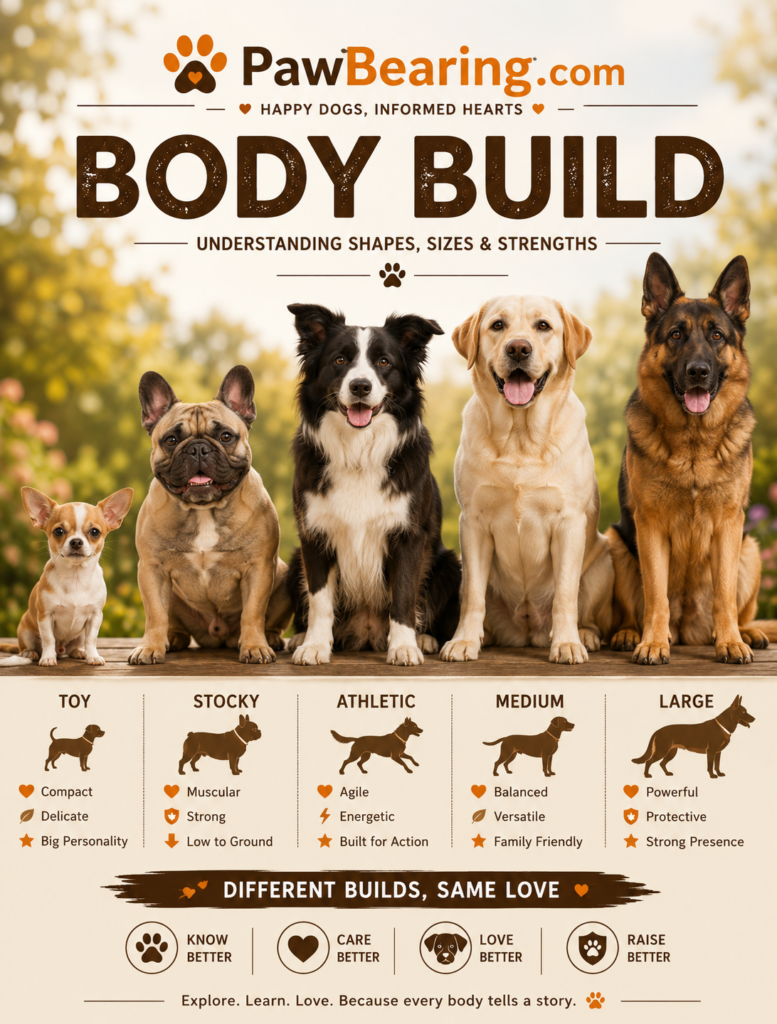
CATEGORY: Body build
A muscular dog is instantly recognizable when the coat allows the body to be seen clearly. The shoulders appear defined, the thighs are powerful, the neck may look substantial, and the entire body gives the impression of physical readiness. Even when standing still, the dog can look as though movement is only a moment away.
But muscular does not mean bulky, overweight, or exaggerated.
Muscle is functional tissue. It allows the dog to move, stabilize joints, accelerate, turn, jump, pull, climb, play, and perform the countless small physical actions involved in ordinary life. Every healthy dog has muscle, but some breeds naturally develop far more visible muscular definition because of their genetics, coat, body fat, bone structure, and historical working purpose.
The American Pit Bull Terrier type, Staffordshire Bull Terrier, Boxer, Rottweiler, Doberman Pinscher, Belgian Malinois, American Staffordshire Terrier, and many other breeds can display obvious muscular development, although their proportions and overall builds differ considerably.
A Greyhound is also highly muscular despite appearing lean rather than bulky.
This illustrates an important point: muscular is not one specific silhouette.
Muscle can exist within stocky, compact, long-legged, lean, square, and heavy-boned bodies.
Understanding muscular build therefore requires separating muscle from the other characteristics that shape how a dog looks.
Muscle Is Not the Same as Body Size
A large dog is not automatically more muscular than a smaller dog.
Absolute muscle mass may certainly be greater in a giant dog simply because the entire animal is larger, but muscularity refers partly to how developed muscle is relative to the dog’s own frame.
A medium-sized dog can look extraordinarily muscular because its shoulders, thighs, and neck are strongly developed and clearly visible.
A much larger dog may have more total muscle but appear softer because of coat, body fat, or different structural proportions.
This is why judging muscularity from weight alone makes little sense.
The body needs to be viewed as a complete system.
Muscle Is Not the Same as Heavy Bone
Heavy bone describes the substance of the skeletal framework.
Muscle surrounds and moves that framework.
A dog can therefore have substantial bone without dramatic muscular definition.
Another can have relatively moderate bone and still be extremely muscular.
The distinction becomes obvious when comparing breeds.
A massive livestock guardian may possess heavy bone and substantial muscle but hide much of it beneath a thick coat.
A smooth-coated athletic breed may reveal every muscle despite having a much lighter skeletal frame.
Both can be powerful dogs.
Their bodies express that power differently.
Muscle Is Not the Same as Fat
This is one of the most important distinctions in body-build assessment.
Both muscle and fat add volume and weight.
But they do not create the same shape.
Muscle tends to produce defined contours around the shoulders, thighs, neck, back, and chest.
Excess body fat can soften those contours and make the waist less distinct.
A muscular dog can become overweight.
When that happens, the underlying muscle may still be present, but it becomes covered by additional fat.
The dog can therefore remain impressive in size while becoming less appropriately conditioned.
Why Some Breeds Develop Obvious Muscle
Genetics strongly influence muscle development.
Different breeds were historically selected for different physical tasks.
Some needed strength.
Others needed explosive acceleration.
Some needed endurance.
Others required the ability to control livestock, guard property, retrieve game, pull loads, or perform demanding physical work.
Over generations, the dogs best suited to those jobs contributed disproportionately to later breeding populations.
The physical result remains visible today.
Many modern dogs no longer perform their historical work, but their bodies still carry the structural characteristics associated with it.
The Staffordshire Bull Terrier Shows Compact Muscle
The Staffordshire Bull Terrier provides a clear example of muscle concentrated within a relatively compact body.
The breed’s physical presence often seems greater than its height suggests.
The chest, shoulders, neck, and hindquarters can all appear powerful.
Short coat makes muscular definition easy to see.
This creates a distinctive contrast with a taller athletic dog.
Both may be fit and strong, but one concentrates physical substance within a shorter frame while the other distributes it through longer limbs and a taller body.
The Boxer Combines Muscle With Square Proportions
The Boxer demonstrates another form of muscular construction.
Its body is athletic and powerful while maintaining a relatively balanced, square outline.
The chest is developed, the hindquarters strong, and the overall impression is energetic rather than heavy.
This shows why muscular and stocky should not be treated as synonyms.
A Boxer can look powerful without creating the same low, dense silhouette associated with more compact dogs.
The Doberman Shows a Leaner Muscular Type
The Doberman Pinscher often displays muscle through a more refined frame.
The body can appear clean, athletic, and relatively elegant while still carrying substantial functional muscle.
The shoulders, chest, back, and hindquarters work within a lighter-looking silhouette than many stockier breeds.
This is particularly useful for understanding how body fat influences appearance.
With a short coat and appropriate condition, muscular contours are relatively visible.
The dog can look powerful without looking bulky.
Belgian Malinois: Muscle Built for Work
The Belgian Malinois provides another interpretation.
The breed is athletic, relatively light, and designed around high levels of physical activity.
Muscle is functional rather than ornamental.
The body needs to accelerate, jump, change direction, run, climb, and work for prolonged periods.
This creates a very different muscular impression from a broad, heavy-bodied breed.
Power does not always come from mass.
Sometimes it comes from the relationship between strength, speed, coordination, and efficiency.
Greyhounds Prove Lean Dogs Can Be Extremely Muscular
A Greyhound may appear slim from a distance, but its hindquarters reveal extraordinary muscle development.
This is necessary for rapid acceleration and high-speed running.
The narrow waist and low body fat make the muscles even more visible.
This is why the word “skinny” can be so misleading when applied to athletic breeds.
The dog may carry relatively little unnecessary fat while possessing powerful functional muscle.
Lean and muscular can coexist perfectly.
Short Coats Make Muscle Easier to See
Coat dramatically affects human perception.
Smooth-coated dogs reveal body contours directly.
Shoulders, thighs, ribs, waist, and neck structure are easy to observe.
This can make a moderately muscular smooth-coated dog appear more athletic than a heavily muscled long-coated breed.
The muscle did not disappear beneath the hair.
It simply became less visible.
For heavily coated dogs, hands-on assessment becomes more informative than visual inspection alone.
Muscle Develops Through Use
Genetics provides potential.
Activity helps develop and maintain muscle.
A dog that regularly walks, runs, plays, climbs, trains, and performs suitable physical activities uses its body differently from a dog living a mostly sedentary life.
Muscle responds to appropriate demand.
However, dogs should not be exercised as though they were human bodybuilders.
The objective is functional conditioning rather than creating the largest possible muscles for appearance.
Conditioning Is a Gradual Process
A muscular-looking dog can still be unconditioned.
This seems contradictory until we separate structure from fitness.
A dog may naturally possess substantial muscle because of genetics while lacking cardiovascular endurance after months of inactivity.
It may be able to produce short bursts of power but tire quickly during prolonged activity.
Therefore, exercise should increase gradually.
Do not assume that a dog that looks athletic can immediately complete a long run, difficult hike, or demanding training session.
Puppies Should Not Be “Bulking”
Owners of muscular breeds sometimes become interested in producing an impressive adult physique very early.
A puppy is not a miniature adult athlete.
Its bones, joints, muscles, coordination, and growth plates are still developing.
The objective during growth is appropriate development, not maximum visible muscle.
Overfeeding in an attempt to make a puppy appear broader or more powerful can create excess body weight rather than desirable muscular development.
Time, genetics, proper nutrition, and age-appropriate activity produce the adult body.
Adolescents Can Look Narrow Before They Mature
A young dog may reach much of its adult height before developing its mature chest and musculature.
This creates an adolescent stage that can look surprisingly lean.
The head may seem too large.
The limbs appear long.
The chest seems unfinished.
Later, the body develops more adult substance.
Owners often describe this process as “filling out.”
Normal maturation should not be confused with fattening the dog.
Muscles Need Recovery Too
Physical training produces stress on muscles.
Recovery allows adaptation.
A dog performing demanding activities every day without appropriate rest may not become fitter simply because it is exercising more.
Fatigue can reduce coordination and performance.
The appropriate balance depends on the activity, intensity, age, health, and individual dog.
A family companion playing energetically in the garden has very different requirements from a working or sporting dog.
Conditioning should match purpose.
Walking Builds More Than People Think
Walking may seem too simple to count as conditioning, but regular walking provides valuable physical activity for many dogs.
Terrain changes can increase challenge.
Moderate hills ask more from the hindquarters.
Different surfaces require balance and coordination.
Longer walks can improve endurance when increased progressively.
Not every muscular dog needs elaborate canine fitness equipment.
Consistent everyday movement remains the foundation.
Running Is Not Suitable for Every Dog at Every Stage
Running can be excellent exercise for some healthy adult dogs.
But age, breed, joint health, temperature, surface, conditioning, and individual anatomy all matter.
A young growing dog should not automatically be taken on prolonged forced runs simply because it belongs to an athletic breed.
Likewise, a previously sedentary adult should not suddenly be expected to run several kilometers.
Build capacity progressively.
Swimming Can Offer a Different Type of Exercise
Many dogs enjoy swimming, and where appropriate it can provide exercise without the same impact pattern as running.
But not every dog is a natural or confident swimmer.
Body shape matters.
Temperament matters.
Water conditions matter.
Safety equipment may be appropriate in some situations.
Never assume that a muscular dog will automatically swim well simply because it is physically strong.
Introduce water carefully and supervise.
Tug and Play Use Real Muscle
Play can be physically demanding.
Tugging, chasing, retrieving, wrestling with suitable canine companions, and other active games recruit muscles throughout the body.
These activities also provide mental stimulation.
The key is control.
The surface should provide traction.
The intensity should suit the dog.
Puppies, seniors, and dogs with orthopedic problems may require different types of play.
A dog’s enthusiasm can exceed its physical readiness.
Strength Does Not Eliminate the Need for Warm-Up
A dog exploding from complete rest into maximum-speed activity places sudden demands on muscles and joints.
For demanding exercise, a period of easier movement beforehand can help transition the body into activity.
A gentle walk before more intense running or sporting work is a simple example.
Likewise, finishing intense activity with calmer movement rather than stopping abruptly can form part of a sensible exercise routine.
Formal conditioning plans for working or sporting dogs may deserve guidance from veterinary or canine rehabilitation professionals.
Protein Does Not Automatically Create More Muscle
Muscle development is often oversimplified into a nutritional equation: more protein equals more muscle.
Dogs require complete and balanced nutrition appropriate to their life stage and circumstances.
But feeding increasingly large amounts of food or adding unbalanced supplements does not automatically produce better muscular development.
Without appropriate activity, excess calories can simply contribute to fat gain.
Dietary changes should be made for nutritional reasons rather than because social media promises a more impressive physique.
Supplements Should Not Replace Veterinary Guidance
A large market exists for supplements marketed toward joints, muscle, performance, recovery, and athletic dogs.
Not every product is necessary.
Not every claim is equally well supported.
Supplements can also interact with medications or create nutritional imbalances depending on what is being given.
If a dog has genuine performance, joint, or recovery concerns, appropriate veterinary advice is more useful than assembling a collection of products based on advertising.
Maintaining a Visible Waist Still Matters
A muscular torso can make a dog appear broad even at a healthy weight.
Nevertheless, appropriate body-condition assessment still applies.
Feel the ribs.
Look for a waist appropriate to the dog’s structure.
Observe the abdominal contour.
If muscular definition gradually disappears beneath a soft layer and the waist becomes less obvious, weight gain may be occurring.
“Muscular breed” should not become an excuse for obesity.
Extra Fat Does Not Make a Dog Stronger
A heavier dog may feel harder to move physically, but this does not mean additional body fat has improved strength.
Strength comes largely from muscles working through the skeletal system.
Fat adds load.
The dog must now move its own extra mass during every step.
Maintaining an appropriate body condition allows the dog’s existing muscle to work without unnecessary additional weight.
Muscle Can Hide Weight Loss
The opposite problem also occurs.
A muscular dog can lose some body fat and still look physically impressive.
If weight loss continues, muscle itself may eventually decline.
Owners should monitor trends.
Unexpected loss of weight, muscle, appetite, energy, or performance deserves veterinary attention.
A powerful appearance can sometimes delay recognition that the dog’s condition is changing.
The Hindquarters Tell Much of the Story
The thighs are one of the easiest places to observe functional muscle.
Powerful hindquarters contribute to acceleration, climbing, jumping, and forward propulsion.
In a well-conditioned dog, the rear should look appropriately developed for the breed and activity level.
Notice symmetry.
If one thigh begins looking noticeably smaller than the other, that can suggest reduced use of the limb and deserves attention.
Muscle changes can sometimes reveal movement problems before they become extremely obvious.
Shoulder Muscles Are Equally Important
The front of the body is not merely being carried passively while the rear does all the work.
The shoulders and supporting muscles absorb forces, stabilize the front, and participate in movement.
A muscular dog’s forequarters may be visually impressive, particularly in broad-chested breeds.
But visible width alone does not tell us whether the dog is moving comfortably.
Function should always be considered alongside appearance.
Core Strength Is Less Visible but Important
Muscles supporting the spine and torso contribute to stability.
They transfer forces between the front and rear portions of the body.
This is particularly important in athletic movement where acceleration, turning, jumping, and stopping place demands on the entire trunk.
Owners often focus on thighs and shoulders because they are easy to see.
The less obvious muscles are equally important to functional movement.
Muscle Should Be Symmetrical
Healthy dogs are not perfectly geometrically identical on both sides, but substantial differences in muscle development deserve attention.
If one hind leg is consistently used less because of pain, muscle may gradually decrease.
The dog may continue functioning by shifting more work onto other limbs.
This compensation can be subtle.
Regularly observing the dog from both sides and from behind can help owners notice changes.
When something looks or feels significantly different, veterinary assessment is appropriate.
Muscular Dogs Can Still Have Joint Problems
Powerful muscles do not make a dog invulnerable.
Athletic dogs can experience injuries and orthopedic conditions just like other dogs.
In some situations, strong muscle may help support the body and compensate for a problem temporarily, making early signs less obvious.
Changes in gait, reluctance to jump, stiffness, reduced performance, altered posture, or unusual sensitivity should be taken seriously.
Fitness does not eliminate medical risk.
Surface Traction Matters During Powerful Movement
A muscular dog accelerating across a polished floor can generate substantial force without much grip.
Feet slide.
The body twists.
Movement becomes uncontrolled.
Secure surfaces are particularly valuable in areas where dogs regularly run, turn, jump, or play.
Rugs and runners can improve traction indoors.
Outdoor exercise surfaces should also be considered when planning high-intensity activities.
Muscular Dogs Can Be Extremely Strong on Lead
Visible muscle has practical consequences.
A dog capable of generating substantial power can pull strongly if lead manners have not been taught.
Harnesses, collars, and other equipment should fit properly, but equipment alone does not create control.
Training matters.
Teaching calm walking while the dog is young and manageable is considerably easier than waiting until an adult muscular dog can physically pull a person across the pavement.
Body Build Influences Harness Fit
Broad, muscular shoulders can make some harness designs difficult to fit.
A harness may be large enough around the chest but too narrow around another area.
Straps can sit too close behind the front legs.
Some designs may interfere unnecessarily with shoulder movement.
Measure carefully and evaluate fit while the dog walks.
The correct equipment should accommodate the dog’s build rather than compress it into a standard shape.
Muscular Dogs and Hot Weather
Exercise produces metabolic heat.
A highly active muscular dog working intensely can become hot regardless of how athletic it appears.
Air temperature, humidity, coat, muzzle shape, body size, fitness, hydration, and health all influence heat tolerance.
Schedule strenuous activity appropriately in warm weather.
Provide access to water and shade.
Observe the dog closely.
Physical power is not protection from overheating.
Cold Weather Can Affect Short-Coated Muscular Dogs
Some muscular breeds have very short coats.
A substantial body may create the impression that they should tolerate cold easily, but coat and individual physiology matter.
A muscular dog with minimal coat can still become uncomfortable in cold wind or rain.
Activity may generate warmth while moving, but the same dog can cool rapidly when standing still.
Respond to actual conditions and the individual rather than assuming muscle is insulation.
Senior Dogs Lose Muscle With Age
Muscle loss can become increasingly noticeable in older dogs.
The thighs may narrow.
The shoulders lose fullness.
The topline can change.
Rising from rest may become harder.
Some age-related change can occur, but significant decline should not simply be ignored.
Nutrition, pain, activity level, neurological conditions, orthopedic disease, and other health factors can influence muscle condition.
Veterinary assessment can help determine whether a change is expected or concerning.
Keeping Senior Dogs Moving Appropriately
Aging does not necessarily mean stopping exercise.
Appropriate movement can help maintain muscle, mobility, mental stimulation, and quality of life.
The type and intensity may need to change.
Shorter walks may replace long strenuous outings.
Controlled movement may become preferable to explosive play.
Surface traction may become more important.
The individual dog’s comfort should guide the routine.
Rehabilitation Can Rebuild Function
Dogs recovering from injury, surgery, or periods of restricted activity may lose significant muscle.
Rebuilding should be progressive.
Veterinary rehabilitation professionals can use carefully selected exercises to address strength, balance, mobility, and controlled return to activity.
Trying to restore lost muscle rapidly through strenuous exercise can overload tissues that are not ready.
Functional recovery requires patience.
Mixed-Breed Dogs Can Be Exceptionally Muscular
Muscular build is not restricted to recognized breeds.
Mixed-breed dogs can inherit powerful shoulders, substantial hindquarters, short coats, broad chests, or lean athletic frames in unique combinations.
One mixed dog may look like a compact power athlete.
Another may have long legs with remarkably developed thighs.
Another may hide considerable muscle under a thick coat.
The individual body is more important than determining which breed “owns” a particular physical characteristic.
Photography Can Exaggerate Muscle Dramatically
Lighting and camera angle can transform the apparent physique of a dog.
Side lighting creates shadows that emphasize muscle definition.
A low camera angle enlarges the chest and shoulders.
Wide-angle lenses exaggerate whatever is closest to the camera.
A dog photographed immediately after exercise may also appear more defined because of posture and muscle engagement.
Social-media images are therefore poor standards for judging how muscular another dog “should” look.
Do Not Chase an Artificial Physique
There is increasing interest online in making dogs appear exceptionally muscular.
This can encourage inappropriate feeding, weighted equipment, excessive exercise, or routines designed more for visual appearance than canine welfare.
A dog should not be trained like a bodybuilding project.
Its body exists to support a life.
Strength, mobility, endurance, comfort, health, and enjoyment matter more than creating dramatic photographs.
Functional Muscle Is the Goal
The best muscular condition is useful.
It helps the dog move comfortably.
It supports ordinary activity.
It allows participation in appropriate work or sport.
It contributes to stability.
It protects against unnecessary deconditioning.
Visible muscle can certainly be beautiful, but appearance should remain a consequence of healthy structure and activity rather than the primary objective.
Muscular Does Not Mean Aggressive
One of the most persistent human biases is associating a muscular body with an aggressive personality.
Physical appearance cannot reliably predict temperament.
A powerful-looking dog may be affectionate, sociable, sensitive, cautious, playful, or extremely gentle.
A much smaller, lighter dog may be more reactive or assertive.
Muscle describes anatomy.
Behavior describes behavior.
The two should not be confused.
Understanding the Powerful Canine Body
The muscular dog demonstrates how structure and function come together.
Bone provides the framework.
Joints allow movement.
Muscles generate and control force.
The chest, spine, shoulders, pelvis, limbs, and feet coordinate as one system.
Different breeds emphasize different parts of that system according to their historical functions.
Some concentrate power inside compact bodies.
Some combine muscle with heavy bone.
Some are tall and athletic.
Others are extremely lean.
This is why “muscular” is not one body shape.
It is one characteristic that can appear across many body shapes.
Strength Should Serve the Dog Throughout Life
The healthiest muscular dog is not necessarily the one with the largest shoulders or most dramatic definition.
It is the dog whose physical condition supports everyday function.
Appropriate weight allows muscles to work without unnecessary additional load.
Regular activity helps maintain strength.
Progressive conditioning reduces the temptation to demand too much too quickly.
Good nutrition supports the body.
Veterinary care identifies problems when movement or muscle condition changes.
And sensible management allows the dog to use its strength rather than simply display it.
Appreciating Muscle as Function, Not Decoration
A muscular canine body is impressive because it reveals what dogs are physically capable of doing.
The shoulders that look powerful in a photograph stabilize a moving animal.
The thighs that appear dramatically defined generate propulsion.
The neck, back, and core help transfer forces through the body.
Muscle is not decoration placed over the skeleton.
It is the machinery that makes the skeleton move.
Once we understand that, the muscular dog becomes more interesting than a collection of visual features.
We see the athlete beneath the appearance.
Whether that athlete is a compact Staffordshire Bull Terrier, a square-built Boxer, a refined Doberman, a working Belgian Malinois, a sprinting Greyhound, or a unique mixed-breed companion, the same principle applies:
Strength is most valuable when it remains balanced, functional, healthy, and suited to the life of the individual dog.
The End
PawBearing.com
 Discover More From Our Family of Websites
 ZodiacBearing (Astrology, Tarot, Numerology, Angel Numbers & Spiritual Guidance)
 Velourana (Beauty, Makeup, Hair Care, Skincare & Beauty Tips)
 HavenBearing (Home, Living, Organization, Décor & Everyday Inspiration)
 PawBearing (Pet Care, Dog Breeds, Animal Health, Training & Pet Products)
 PsyCatherine (Notes From the Journal of a Psychologist on Real Life)