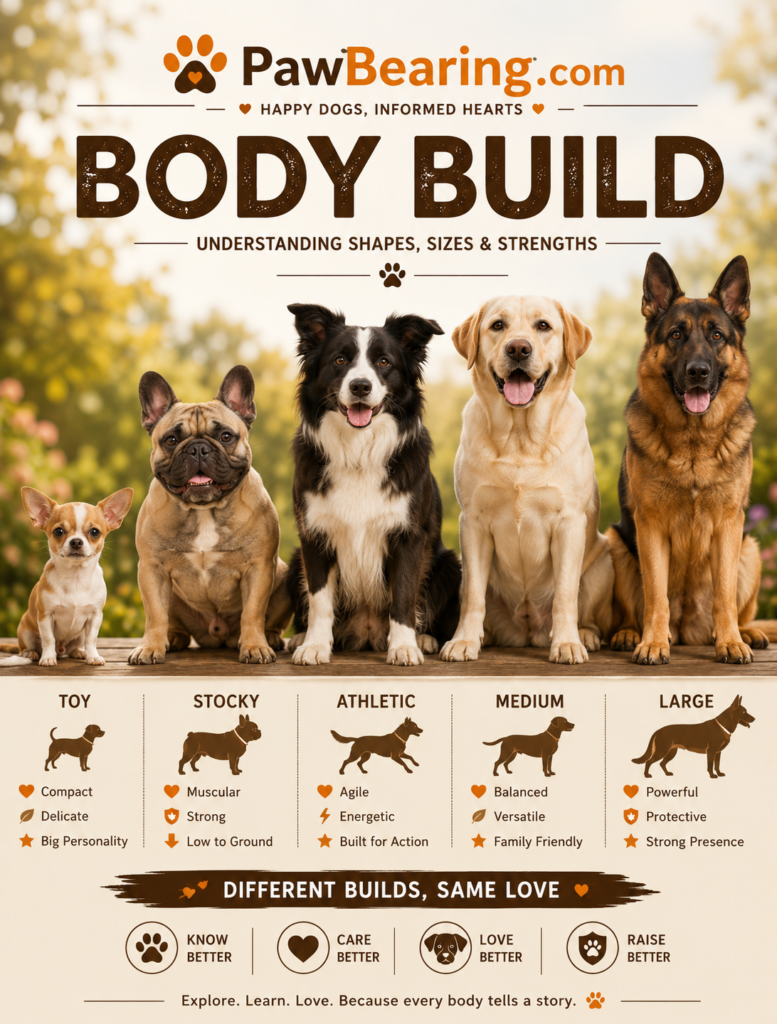
CATEGORY: Body build
Dogs display an extraordinary range of body shapes. A Greyhound can look almost aerodynamic, with long limbs, a deep chest, and a dramatically tucked abdomen. A Bulldog appears compact, broad, and powerful. A Dachshund combines a long body with remarkably short legs, while many livestock guardian breeds are substantial, heavily built dogs designed for strength and endurance.
These differences are not simply cosmetic.
A dog’s body build reflects generations of selective breeding for particular purposes. Humans developed dogs to run, retrieve, herd livestock, enter underground dens, guard property, pull loads, hunt, accompany people, and perform many other jobs. Over time, physical characteristics that helped dogs perform those jobs became associated with particular breeds.
This is why understanding body build can tell us considerably more about a dog than whether it looks “slim,” “stocky,” “tall,” or “short.”
Body build involves proportion, bone, muscle, chest depth, leg length, back length, angulation, overall substance, and the relationship between all these features. Breed standards consequently describe far more than height and weight; they commonly address size, proportion, substance, body, topline, forequarters, hindquarters, feet, and gait.
Learning to recognize these differences provides a fascinating way to understand why dogs look—and often move—the way they do.
Body Build Is Not the Same as Body Weight
One of the first distinctions to understand is the difference between build and weight.
A dog can naturally have a heavy build without being overweight.
Another dog can naturally have a very slender build without being underweight.
Consider two healthy adult dogs of similar height. One breed may have substantial bone, a broad chest, powerful shoulders, and heavy musculature. The other may have fine bone, long legs, a narrow waist, and a much lighter overall structure.
Their healthy weights could be dramatically different.
Body build describes the dog’s underlying physical construction.
Body condition describes, among other things, how much fat is carried over that structure.
Veterinary body-condition assessment therefore looks at features such as whether the ribs can be felt, whether a waist is visible from above, and whether an abdominal tuck is present. An ideal canine body condition generally includes ribs that can be felt beneath a slight fat covering, a visible waist, and an abdominal tuck.
Those measurements should not be confused with breed type.
A naturally broad, muscular dog should not be expected to develop the silhouette of a sighthound, and a naturally lean sighthound should not be deliberately fattened simply because someone thinks it looks “too skinny.”
Why Dogs Developed Such Different Builds
Much of canine diversity makes sense when viewed through historical function.
Dogs were not originally developed according to one universal idea of the perfect canine body.
Different jobs demanded different physical solutions.
A dog expected to pursue fast-moving prey across open land benefited from speed, stride length, and an efficient running structure.
A dog working underground needed a body capable of navigating confined spaces.
A powerful working dog required sufficient substance and musculature for physically demanding tasks.
A herding dog might need endurance, agility, and the ability to change direction rapidly.
Breed standards preserve many of these characteristics. Standards describe the physical qualities that distinguish breeds and often reflect the work for which those breeds were historically developed.
This relationship between function and form explains why canine anatomy is so diverse.
The Square-Built Dog
When describing canine proportions, the word “square” does not mean the dog literally resembles a box.
It refers to the relationship between height and body length.
A square dog is approximately as long from the point of the shoulder to the rear of the body as it is tall at the withers.
This creates a balanced, upright silhouette.
Several breeds are described as square or nearly square in their standards, although the exact method of measurement and acceptable proportions vary between breeds.
The square build can be associated with compactness and efficient movement, but it should never be interpreted independently of the rest of the dog’s anatomy.
Two breeds can both be approximately square and still look completely different because their bone, chest, head, coat, musculature, and limb proportions are different.
Dogs That Are Longer Than Tall
Many breeds are intentionally somewhat longer in body than they are tall.
This can be subtle.
A dog may appear almost square until its proportions are examined carefully.
In other breeds, the difference is immediately obvious.
The reasons vary according to breed history and function.
Breed standards may specify different height-to-length relationships because structural proportions form part of the characteristic construction and movement of each breed.
“Longer than tall” therefore covers an enormous spectrum.
It does not automatically mean extremely long-backed.
Long and Low Dogs
At the more dramatic end of canine proportion are dogs whose bodies are long relative to their short legs.
The Dachshund is perhaps the most recognizable example.
This body type was not created merely because people found short legs attractive.
Historically, low stature could help dogs work close to the ground and, in certain breeds, pursue quarry into confined spaces.
Similar low-set proportions appear in several breeds developed for different purposes.
These dogs illustrate an important principle of canine structure:
Leg length dramatically changes how we perceive body length.
A dog with a moderately long body and very short legs can appear much more elongated than another dog with similar trunk length but taller limbs.
The Leggy, Athletic Build
At the opposite end are dogs whose long legs contribute strongly to their silhouette.
Some appear elegant and light.
Others combine long limbs with substantial muscle and bone.
Leg length influences stride, ground clearance, movement, and overall appearance, but long legs alone do not define athletic ability.
The relationship between shoulders, pelvis, spine, musculature, feet, and joints matters enormously.
Canine movement involves the entire structure rather than simply the limbs. The hindquarters provide much of the propulsion, while the rest of the dog’s construction determines how effectively that force becomes forward movement.
The Sighthound Silhouette
Few canine body types are as instantly recognizable as that of the classic sighthound.
Think of the Greyhound.
The body is built around athletic movement.
Long limbs, a deep chest, comparatively narrow waist, abdominal tuck, and powerful hindquarters combine to create a distinctive silhouette.
The deep chest provides substantial thoracic space while the abdominal region rises dramatically behind it.
This creates the familiar curved underline.
The result can look extremely lean compared with many companion breeds.
That appearance is why understanding breed-specific build is important.
Judging every dog according to the same visual expectations would make little sense.
The Compact Build
Compact dogs appear tightly assembled rather than elongated.
Their body parts seem closely integrated, and the distance between major structural points may appear relatively short.
Compactness can occur in small, medium, or larger dogs.
It should not automatically be confused with heaviness.
A dog can be compact and relatively light.
Another can be compact and extremely substantial.
In canine conformation terminology, compactness generally refers to a firmly integrated body whose parts create a closely assembled overall structure.
This is a useful reminder that everyday words sometimes have more specific meanings when discussing canine conformation.
Heavy-Boned and Substantial Dogs
Some dogs possess considerable substance.
Their legs may have visibly heavier bone.
Their chests may be broad and deep.
Their necks, shoulders, and hindquarters may carry substantial muscle.
The overall impression is strength.
Large working and guardian breeds often demonstrate this kind of construction, although each breed has its own correct proportions.
Substance should also remain proportionate.
A dog is not automatically better built because it is heavier.
Excessive body weight is not the same as appropriate breed substance, and exaggerated bulk does not necessarily improve functional ability.
Fine-Boned Dogs
At the other end of the spectrum are dogs with comparatively fine skeletal structure.
This is particularly visible in some toy breeds and light athletic breeds.
Their limbs may appear slender and elegant.
Their bodies can look delicate compared with heavier dogs of similar height.
Fine bone does not necessarily mean fragility or poor health.
It may simply be characteristic of the breed.
However, the physical scale of the dog should influence everyday handling.
A very small, fine-boned dog may require greater protection from accidental falls, rough play with much larger dogs, or careless handling than a substantial working breed.
Chest Shape Changes the Entire Silhouette
The chest is one of the most important elements of canine body build.
It can be broad or comparatively narrow.
It can be deep or relatively shallow.
Rib shape also varies.
Some dogs have considerable spring of rib, while others appear narrower through the body.
Chest depth is particularly obvious when viewed from the side.
In many breeds, the lower chest reaches approximately toward the elbow area, although correct proportions vary by breed.
A deep chest combined with an abdominal tuck creates a dramatically different silhouette from a broad, compact body with comparatively little tuck-up.
What Is Tuck-Up?
Tuck-up describes the rising contour of the abdomen behind the ribcage.
It is particularly noticeable in breeds such as Greyhounds and other sighthounds.
Viewed from the side, the underside of the dog rises sharply toward the rear rather than remaining relatively level.
Other breeds have moderate tuck-up.
Some have comparatively little.
In structural terms, pronounced tuck-up creates a shallower body at the loin and contributes to the characteristic small-waisted appearance.
Again, the correct amount depends on the breed.
A dramatic Greyhound-style tuck would look completely inappropriate on many other dogs.
The Topline
The topline is the contour running along the upper portion of the dog’s body.
People sometimes assume every dog’s back should appear perfectly horizontal.
Breed standards show otherwise.
Some breeds call for a level topline.
Others have characteristic slopes, curves, or other breed-specific contours.
The topline is created by the relationship between the withers, back, loin, croup, underlying skeletal structure, and musculature.
It also changes visually when a dog moves, stands incorrectly, carries excess weight, or lacks physical condition.
For this reason, evaluating a dog’s structure from one photograph can be misleading.
The Importance of the Loin
The loin occupies the region between the ribcage and pelvis.
Its length and strength influence the overall body shape.
A short loin contributes to a more compact impression.
A longer coupling can contribute to an elongated silhouette.
The loin also plays an important role in movement because forces generated by the hindquarters must transfer through the body.
Breed standards therefore frequently describe this area rather than treating the torso as one undifferentiated shape.
Shoulders Affect More Than Appearance
The shoulder assembly influences the front of the dog’s body and contributes to movement.
The shoulder blade, upper arm, elbow, and associated muscles work together as part of the forequarter.
Different breeds have different ideal angulation according to their intended structure.
A dog’s front should therefore not be evaluated by looking only at whether the chest seems broad.
The underlying relationships matter.
This is one reason experienced conformation judges observe dogs both standing and moving.
The Hindquarters Are the Engine
Powerful hindquarters are characteristic of many athletic and working breeds.
The pelvis, upper thigh, lower thigh, hock, feet, and associated musculature combine to generate propulsion.
The pelvic and thigh muscles play an important role in driving movement.
But enormous muscles alone do not create efficient movement.
Angles and proportions need to work together.
A dog’s rear construction must coordinate with the front assembly and spine.
The entire animal moves as a system.
Muscular Does Not Mean Overweight
Muscle and fat can both add volume to a dog’s body, but they are very different tissues.
A muscular dog may appear powerful through the shoulders, thighs, and back while still maintaining a clearly defined waist.
An overweight dog may lose that definition as fat accumulates over the ribs, waist, abdomen, and tail base.
This is why weighing a dog alone provides incomplete information.
Veterinary body-condition scoring includes physical assessment of the ribs and silhouette rather than relying solely on the number displayed by the scale.
Two dogs weighing exactly 30 kilograms can have completely different body conditions.
Coat Can Hide the Real Body
Long or dense coats can dramatically change perceived body shape.
A heavily coated dog may appear broader, rounder, or shorter-legged than it actually is.
A smooth-coated dog reveals almost every structural contour.
This makes visual assessment from photographs particularly unreliable when comparing breeds.
Underneath an enormous coat may be a surprisingly moderate frame.
Grooming can further alter the silhouette by emphasizing the chest, legs, head, or waist.
When evaluating actual body condition, hands are often more informative than eyes.
Puppies Are Not Miniature Adults
Puppies change proportions dramatically as they grow.
At different developmental stages they may appear long-legged, narrow, awkward, rear-high, or temporarily out of proportion.
Different breeds mature at different rates.
Large and giant breeds generally require substantially more time to reach their mature physical form than many small breeds.
Judging a young dog’s eventual adult build from one developmental stage can therefore be misleading.
Growth is a process of changing proportions, not simply enlargement of an already finished adult shape.
Male and Female Build Can Differ
Sexual dimorphism—the physical difference between males and females—varies between breeds.
In some breeds, adult males are noticeably larger and more substantial.
Females may appear somewhat lighter or more refined while still clearly demonstrating correct breed type.
In other breeds, the differences are less dramatic.
Breed standards often specify separate acceptable height ranges for males and females.
These distinctions are another reason broad descriptions such as “medium build” provide only limited information.
Mixed-Breed Dogs Can Combine Structures in Unexpected Ways
Mixed-breed dogs demonstrate just how many structural characteristics can be inherited independently.
A dog may inherit relatively short legs from one side of its ancestry and a deeper chest from another.
The head may look strongly associated with one breed while the torso resembles something entirely different.
Coat can make the ancestry appear even more deceptive.
This is why visual breed identification of mixed dogs is inherently uncertain.
Body build can provide clues, but it cannot reliably reconstruct a dog’s genetic ancestry by itself.
Body Build Influences Movement
A dog’s proportions affect how it travels across the ground.
Long-legged dogs, short-legged dogs, square dogs, and elongated dogs do not necessarily use identical movement patterns.
Breed function also matters.
Dogs historically expected to cover large distances may have been selected for efficient, enduring movement.
Others required rapid acceleration, agility, power, or the ability to maneuver through restricted environments.
Breed standards consequently often include gait alongside physical structure because movement provides information about how the dog’s construction works dynamically.
A body is not merely something to observe while standing still.
Structure and Lifestyle Should Be Considered Together
Body build can offer clues about the physical activities a dog may enjoy, but appearance alone should never determine an exercise program.
Breed, age, health, conditioning, temperature, terrain, and individual temperament all matter.
A powerful-looking dog is not automatically prepared for strenuous exercise.
A slender dog is not automatically an endurance athlete.
Physical conditioning develops gradually.
Exercise should suit the individual rather than an assumption based solely on silhouette.
Extreme Builds Deserve Thoughtful Management
Some breeds possess deliberately distinctive proportions that differ greatly from the generalized canine shape.
Very short limbs, extremely long backs, very heavy bodies, or other pronounced characteristics may influence practical decisions around exercise, jumping, stairs, handling, equipment, and weight management.
The correct approach depends on the individual dog.
Owners should avoid assuming that because a structural characteristic is typical of a breed, every possible activity is automatically suitable.
Veterinary advice becomes particularly valuable when deciding exercise or weight-management strategies for an individual dog.
Breed Standards Are Blueprints, Not Beauty Contests for Pets
Breed standards can be fascinating resources for understanding why dogs are constructed differently.
They describe the ideal characteristics associated with a particular breed, including its proportions, substance, structure, movement, and other distinguishing traits.
But a beloved companion dog does not need to be a perfect representation of a show standard to be valuable.
For pet owners, standards are most useful as educational documents.
They explain why a breed looks the way it does and preserve information about its historical function.
They should not become a reason to value one family dog more highly than another.
Learn to Look at Proportion Rather Than Size Alone
When people describe dogs, size usually comes first.
Small.
Medium.
Large.
Giant.
But two large dogs can be almost opposites structurally.
One may be tall, lean, and narrow.
Another may be broad, heavy-boned, and compact.
A third may be long-bodied and comparatively low.
A fourth may combine height with substantial mass.
Body build therefore provides another dimension for understanding breeds.
Look at the relationship between height and length.
Notice leg length.
Observe chest depth.
Look at the waist and abdominal tuck.
Consider bone and muscle.
Watch the dog move.
The more features you observe together, the more meaningful the overall picture becomes.
Healthy Build Is About the Individual Dog
There is no single ideal canine silhouette.
Trying to make every dog resemble the same generalized “fit dog” ignores the enormous structural diversity humans have created across breeds.
A Greyhound should look like a Greyhound.
A Mastiff should look like a Mastiff.
A Dachshund should look like a Dachshund.
What matters is whether the individual dog’s body condition and physical health are appropriate for its underlying structure.
If there is uncertainty about weight, growth, mobility, exercise tolerance, or body condition, a veterinarian can assess the dog directly rather than relying on photographs or generic weight charts.
Body Build Tells Part of the Story of the Dog
A dog’s body is a record of function, ancestry, and selective breeding.
Long legs can tell a story about movement.
A deep chest changes the silhouette and physical proportions.
Powerful hindquarters reveal the importance of propulsion.
Short legs can reflect historical working requirements.
Heavy bone can accompany substantial working construction.
Compactness, length, angulation, musculature, and chest shape combine differently in every breed.
That is what makes canine structure so fascinating.
Dogs are not simply the same animal offered in different sizes and coats.
Their underlying construction can be profoundly different.
Understanding body build allows us to look beyond labels such as small, medium, and large and appreciate how each dog’s proportions work together.
Once you begin noticing those relationships, a walk through a park becomes an anatomy lesson.
You start seeing the deep-chested runner, the compact companion, the substantial guardian, the low-set worker, and the agile herder—not merely as dogs of different appearances, but as variations on one extraordinarily adaptable canine body.
The End
PawBearing.com
 Discover More From Our Family of Websites
 ZodiacBearing (Astrology, Tarot, Numerology, Angel Numbers & Spiritual Guidance)
 Velourana (Beauty, Makeup, Hair Care, Skincare & Beauty Tips)
 HavenBearing (Home, Living, Organization, Décor & Everyday Inspiration)
 PawBearing (Pet Care, Dog Breeds, Animal Health, Training & Pet Products)
 PsyCatherine (Notes From the Journal of a Psychologist on Real Life)