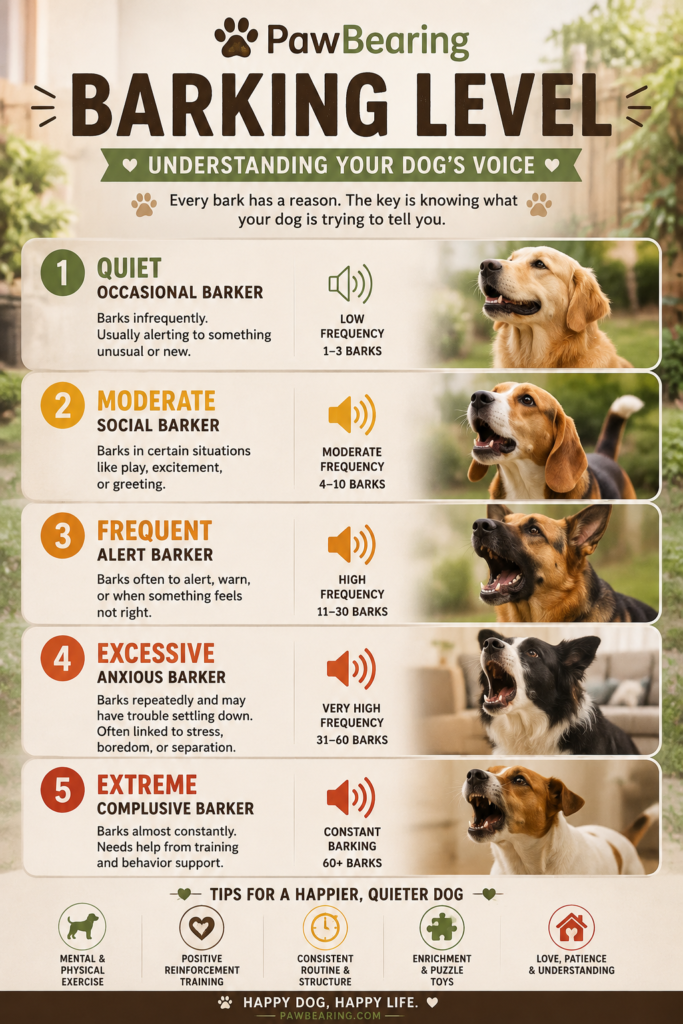
CATEGORY: Barking Level
Few sounds are as closely associated with dogs as barking. It is one of the first behaviours people think about when imagining life with a canine companion. Yet despite hearing dogs bark every day, many owners still misunderstand what barking actually means. A bark is often treated as nothing more than noise, something to stop as quickly as possible, rather than an important form of communication.
In reality, barking is one of the richest ways dogs express themselves. Just as humans use different tones of voice depending on whether they are happy, frightened, excited, frustrated, or concerned, dogs also change the volume, rhythm, pitch, and frequency of their barking to communicate different emotions and intentions.
Learning to understand these vocal signals transforms the relationship between owner and dog. Instead of reacting with frustration every time a dog barks, owners begin asking a far more useful question:
“What is my dog trying to tell me?”
Answering that question often reveals the real cause of the behaviour. Sometimes the dog is simply greeting visitors. At other times it may be protecting its family, asking for attention, responding to fear, expressing boredom, or warning about something unusual in the environment.
Understanding the different types of barking not only improves communication but also makes training significantly more effective. Rather than suppressing every bark, owners learn to respond appropriately to the emotion or need behind it, creating a calmer and more trusting relationship.
Barking Is a Natural Form of Communication
Dogs communicate in many different ways.
They use:
- Body posture.
- Tail movement.
- Facial expressions.
- Ear position.
- Eye contact.
- Scent.
- Vocal sounds.
Barking is simply one part of this larger communication system.
Unlike humans, dogs cannot explain how they feel with words.
Instead, they combine body language with vocalisation to communicate their emotional state.
A bark should therefore always be interpreted together with the dog’s posture and the surrounding situation rather than in isolation.
Alert Barking
Alert barking is probably the easiest type to recognise.
A dog notices something unusual and immediately informs the household.
Possible triggers include:
- Someone approaching the front door.
- A passing stranger.
- An unfamiliar vehicle.
- Wildlife in the garden.
- Unexpected noises.
Alert barking usually stops once the owner acknowledges the situation.
Many guarding breeds naturally excel at this behaviour because they were selectively bred to protect homes and property.
Rather than trying to eliminate alert barking completely, owners often benefit from teaching the dog that a few warning barks are enough before settling quietly again.
Territorial Barking
Territorial barking occurs when a dog believes its home, garden, or family requires protection.
Unlike simple alert barking, territorial barking often continues until the perceived intruder leaves the area.
Common triggers include:
- Delivery drivers.
- Neighbouring dogs.
- Visitors approaching fences.
- People walking past windows.
Dogs displaying territorial behaviour may stand tall, lean forward, raise their tail, and maintain focused attention on the perceived threat.
Training should focus on helping the dog remain calm while teaching that not every passer-by requires a defensive response.
Excitement Barking
Many dogs bark simply because they are happy.
Excitement barking often occurs during:
- Play.
- Walk preparation.
- Greetings.
- Returning family members.
- Favourite games.
- Mealtimes.
The dog’s body language is usually relaxed and energetic.
Tail wagging, bouncing movements, and playful expressions accompany the vocalisation.
Although harmless, owners may wish to encourage calmer greetings to prevent excitement from becoming overwhelming.
Rewarding quiet behaviour before opening doors or beginning games often produces excellent results.
Attention-Seeking Barking
Dogs quickly learn which behaviours attract human attention.
If barking consistently results in interaction, some dogs begin using it intentionally.
Attention-seeking barking may occur when the dog wants:
- Food.
- Play.
- Affection.
- Outdoor access.
- A favourite toy.
The challenge for owners is responding consistently.
Giving attention immediately after barking may unintentionally reward the behaviour.
Instead, rewarding quiet behaviour teaches the dog more appropriate ways of requesting interaction.
Fear and Anxiety Barking
Not all barking reflects confidence.
Some dogs bark because they feel uncertain or frightened.
Possible triggers include:
- Loud noises.
- Unfamiliar people.
- Strange environments.
- Veterinary visits.
- Fireworks.
- Thunderstorms.
Fear barking is often accompanied by cautious body language, lowered posture, or attempts to increase distance from the source of concern.
Punishment should never be used in these situations.
Helping the dog build confidence through positive experiences is usually far more effective.
Boredom Barking
Dogs require regular mental and physical stimulation.
When left alone for long periods without meaningful activity, some dogs begin barking simply to occupy themselves.
Signs may include:
- Repetitive barking.
- Restlessness.
- Pacing.
- Destructive behaviour.
- Digging.
- Chewing.
Addressing boredom involves improving the dog’s daily routine rather than simply trying to silence the barking.
Additional exercise, enrichment toys, scent games, training sessions, and social interaction often reduce boredom-related vocalisation significantly.
Frustration Barking
Frustration occurs when a dog wants something but cannot reach it.
Examples include:
- Seeing another dog through a fence.
- Watching wildlife.
- Being prevented from greeting visitors.
- Waiting for play.
This type of barking often sounds intense because the dog experiences conflicting emotions.
Teaching impulse control and rewarding calm behaviour helps many dogs manage frustration more successfully.
Separation-Related Barking
Some dogs bark primarily when left alone.
This behaviour may indicate separation-related distress rather than simple loneliness.
Owners often notice:
- Barking shortly after leaving.
- Howling.
- Scratching at doors.
- Destructive behaviour.
- Restlessness.
Helping these dogs usually requires gradual independence training combined with predictable routines and confidence-building exercises.
Early intervention often prevents the problem from becoming more severe.
Learning to Read the Whole Dog
Perhaps the biggest mistake owners make is focusing only on the sound.
Instead, observe:
- Tail position.
- Ear position.
- Facial expression.
- Body posture.
- Movement.
- Environment.
- Timing.
The same bark may have completely different meanings depending on these accompanying signals.
The more familiar you become with your own dog’s body language, the easier it becomes to understand what each bark is communicating.
Responding Instead of Reacting
Successful dog owners rarely respond automatically to barking.
Instead, they pause and ask:
Why is my dog barking?
Is the dog excited?
Afraid?
Protective?
Bored?
Seeking attention?
Once the cause becomes clear, the appropriate response usually becomes obvious.
Training should always address the underlying reason rather than the bark itself.
This approach strengthens communication while helping dogs feel understood and secure.
Final Thoughts
Barking is one of the most important ways dogs communicate with the people around them. Whether the cause is excitement, fear, alertness, boredom, frustration, territorial behaviour, or a desire for attention, every bark carries information about the dog’s emotional state and perception of its environment. Learning to recognise these different types of barking allows owners to respond thoughtfully instead of reacting with frustration, leading to more effective training and a stronger bond between human and canine.
Rather than viewing barking as a problem to eliminate, it is far more helpful to see it as part of a dog’s natural language. By paying attention to body language, understanding common triggers, providing appropriate exercise and mental stimulation, and using positive training methods, owners can guide their dogs toward calmer behaviour while still respecting their instinct to communicate. The result is a happier, more confident dog and a more enjoyable relationship built on understanding rather than misunderstanding.
The End
PawBearing
 Discover More From Our Family of Websites
 ZodiacBearing (Astrology, Tarot, Numerology, Angel Numbers & Spiritual Guidance)
 Velourana (Beauty, Makeup, Hair Care, Skincare & Beauty Tips)
 HavenBearing (Home, Living, Organization, Décor & Everyday Inspiration)
 PawBearing (Pet Care, Dog Breeds, Animal Health, Training & Pet Products)
 PsyCatherine (Notes From the Journal of a Psychologist on Real Life)